
Date: November 18, 2026
Perspective: Senior Regional Analyst
Status: Border Fortification / Escalating Air Attrition / Tri-Border Squeeze
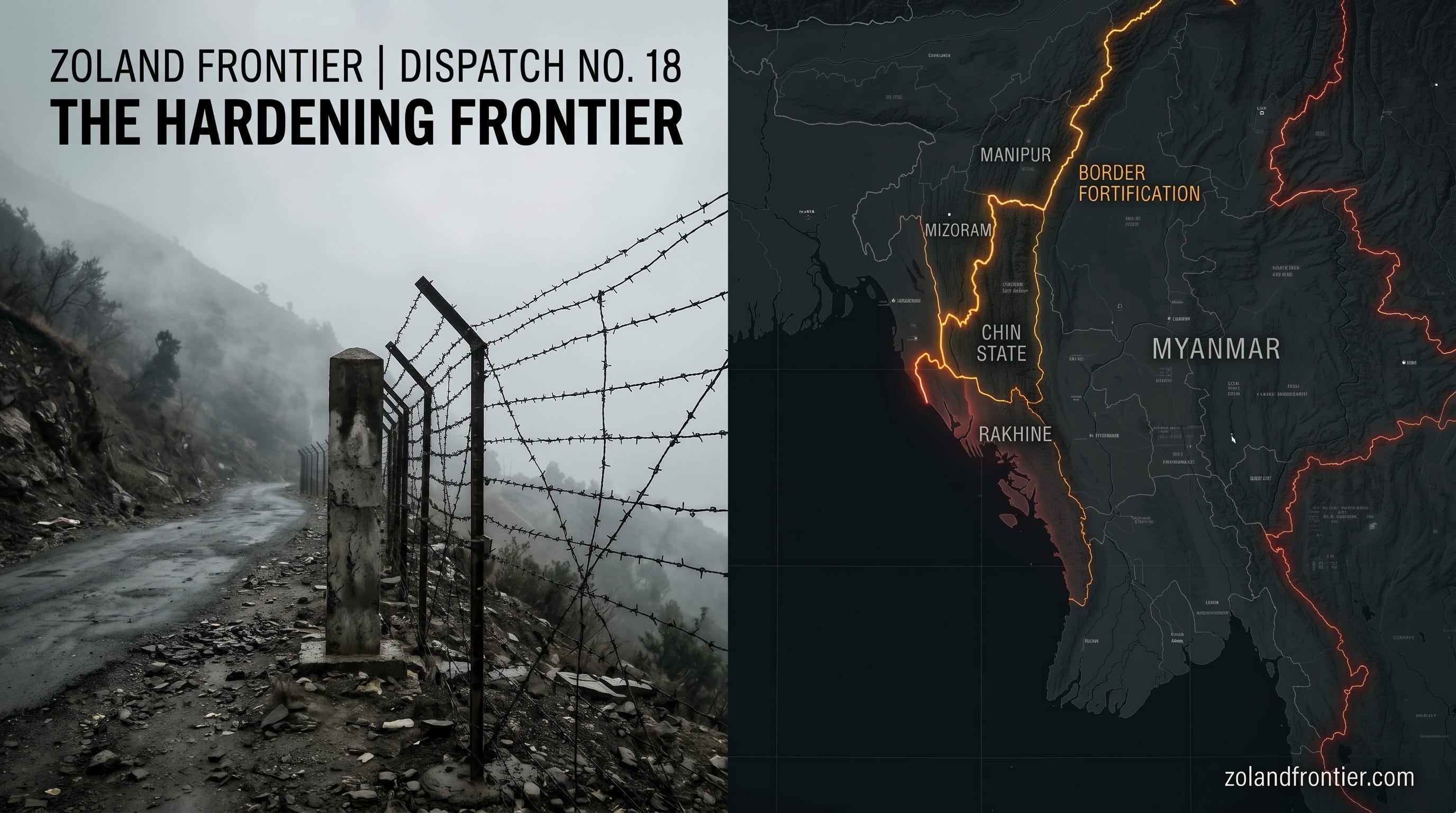
As 2026 draws to a close, the geopolitical architecture of the India–Myanmar–Bangladesh tri-border region is undergoing a fundamental physical transformation. Where colonial-era borders once functioned as porous zones of ethnic kinship and informal trade, state capitals in New Delhi and Dhaka are racing to impose hard Westphalian barriers—even as armed conflict and aerial bombardment intensify on the Myanmar side of the frontier.
Across the contiguous highlands linking Manipur, Mizoram, Chin State, Rakhine, and the Chittagong Hill Tracts (CHT), local populations and non-state actors are entering a new phase of structural containment.
I. The Indo-Myanmar Border: Biometrics, Barbed Wire, and the 2028 Deadline
Following the unilateral scrapping of the Free Movement Regime (FMR) (Dispatch No. 3) and mid-year anxieties over proposed border pillar realignments in Manipur’s Chandel sector (Dispatch No. 16), New Delhi has accelerated its border fortification initiative along the Indo-Myanmar frontier.
The 2028 Construction Blitz: In November 2026, Manipur authorities formally set a 2028 target to complete physical fencing across the state’s 398-km frontier with Myanmar. While construction in rugged terrain remains slow—with roughly 9.2 km completed and another 20.8 km authorized in the Moreh sector by late October—the Centre is simultaneously rolling out electronic surveillance trials and biometric verification protocols within a 10-km border belt.
The Administrative Stalemate: Hardening the external border has done little to resolve Manipur’s internal fracture (Dispatch No. 2). Following the Kuki Inpi Manipur’s (KIM) August rejection of Chief Minister Y. Khemchand Singh’s Kangpokpi outreach (Dispatch No. 16), political dialogue remains deadlocked over demands for a “Separate Administration”, leaving the Assam Rifles stretched between policing domestic buffer zones and enforcing new cross-border restrictions.
The Mizoram Sanctuary: Neighboring Mizoram continues to absorb the human spillover from both Myanmar and Bangladesh (Dispatch No. 7; Dispatch No. 14), while balancing internal debates over the 1986 Peace Accord and Inner Line Permit governance (Dispatch No. 16) alongside heightened Assam Rifles anti-narcotics operations along the Manipur–Mizoram–Tripura corridors.
II. The Western & Southern Chin–Rakhine Front: Aerial Attrition at the Gates
While New Delhi builds fences to contain spillover, the Myanmar Armed Forces (Tatmadaw) has escalated aerial and ground pressure along the western gateways bordering India and Bangladesh.
Southern Chin Counter-Offensives: Beginning in October 2026, military columns anchored by the 77th Light Infantry Division launched a renewed push north from Kyindwe toward Kanpetlet Township, attempting to threaten the eastern approaches to Paletwa—the strategic Arakan Army (AA) stronghold linking Rakhine to Mizoram and India’s Kaladan Multi-Modal Transit Transport Project (Dispatch No. 5A; Dispatch No. 5B).
Unrelenting Airpower: Unable to dislodge resistance forces on the ground, the military has relied on heavy aerial bombardment against civilian infrastructure and displacement hubs (Dispatch No. 17). Following late-September strikes in Kyauktaw Township that killed roughly 50 people (Reuters), regime jets and transport aircraft struck Thuthey Kone village in Paletwa Township on November 14, killing 12 displaced civilians and injuring 21 others—even as regional leaders convened in Manila for the ASEAN Summit.
The Sittwe & Kyaukphyu Chokehold: In Rakhine State, late-October shelling in central Sittwe documented by Médecins Sans Frontières (MSF) and AA riverine strikes on the Kaladan corridor (Dispatch No. 13) have further restricted civilian movement and humanitarian access, reinforcing the reality that territorial control by resistance forces does not insulate communities from aerial attrition (Dispatch No. 6; Dispatch No. 17).
III. The Chittagong Hill Tracts: Multi-Front Squeeze in Bandarban
Across the western frontier in Bangladesh’s Chittagong Hill Tracts (CHT), the smaller Zo kindreds—including the Bawm, Lusai, Pangkhua, Khumi, Mro, and Khiang—remain trapped in an escalating security and demographic squeeze (Dispatch No. 14).
Protracted Insecurity: Official figures presented to the Bangladesh Parliament on November 11, 2026, underscored the human toll across Rangamati, Khagrachhari, and Bandarban over the past five years: at least 316 civilians and security personnel killed and 490 injured in armed clashes, abductions, and counter-insurgency operations involving the Kuki-Chin National Front (KNF) and rival hill factions.
Unilateral Containment: With the Arakan Army controlling the Myanmar side of the border, Dhaka’s mid-2026 pivot toward unilateral border fencing (The Diplomat) has combined with Indian fencing initiatives to create a closed perimeter (Dispatch No. 14). For displaced Zo communities fleeing military crackdowns in Bandarban, traditional cross-border sanctuary routes into Chin State and Mizoram are narrowing rapidly.
IV. Tri-Border Strategic Matrix (November 2026)
SectorPrimary ActorsDominant Dynamic (Late 2026)Strategic ImplicationManipur–Sagaing FrontierIndian MHA, Assam Rifles, KIM, UNC, ZRA-ECBiometric FMR replacement & 2028 fencing deadline
Hardens physical boundaries while leaving internal ethnic and cross-border land disputes unresolved (Dispatch No. 16).
Paletwa–South Chin–RakhineArakan Army (AA), Chin Brotherhood/CPU, TatmadawRegime push via Kyindwe & heavy aerial strikes on IDPs
Threatens civilian survival and complicates India’s Kaladan corridor despite AA territorial dominance (Dispatch No. 13).
Bandarban (CHT)–MizoramBangladesh Army, KNF, Mizoram State GovtOngoing counter-insurgency & unilateral border fencing
Traps Zo kindreds between CHT militarization, demographic pressure, and fenced borders (Dispatch No. 14).
V. Analyst’s Strategic Assessment
The defining trend of late 2026 across the Zoland frontier is asymmetric containment: neighboring states are erecting physical and biometric walls to insulate themselves from Myanmar’s fragmentation, while the conflict inside Myanmar increasingly targets the very civilian networks and supply corridors those borders bisect (Dispatch No. 14; Dispatch No. 17).
For policymakers in New Delhi, Dhaka, and regional humanitarian agencies (UNHCR Myanmar Portal), treating border security purely as an engineering and surveillance exercise risks deepening frontier alienation. Without parallel political frameworks that account for cross-border livelihoods, displaced populations, and local traditional governance, physical fencing will merely compress instability into an already volatile tri-border corridor.
Geopolitics. Security. Transnational kinship. Zoland Frontier brings you essential perspectives from the frontlines of South and Southeast Asia. To sustain this independent, conflict-sensitive analysis, consider supporting our work.