
Date: May 6, 2026
Perspective: Senior Regional Analyst
Status: Strategic Autonomy / Transnational Identity
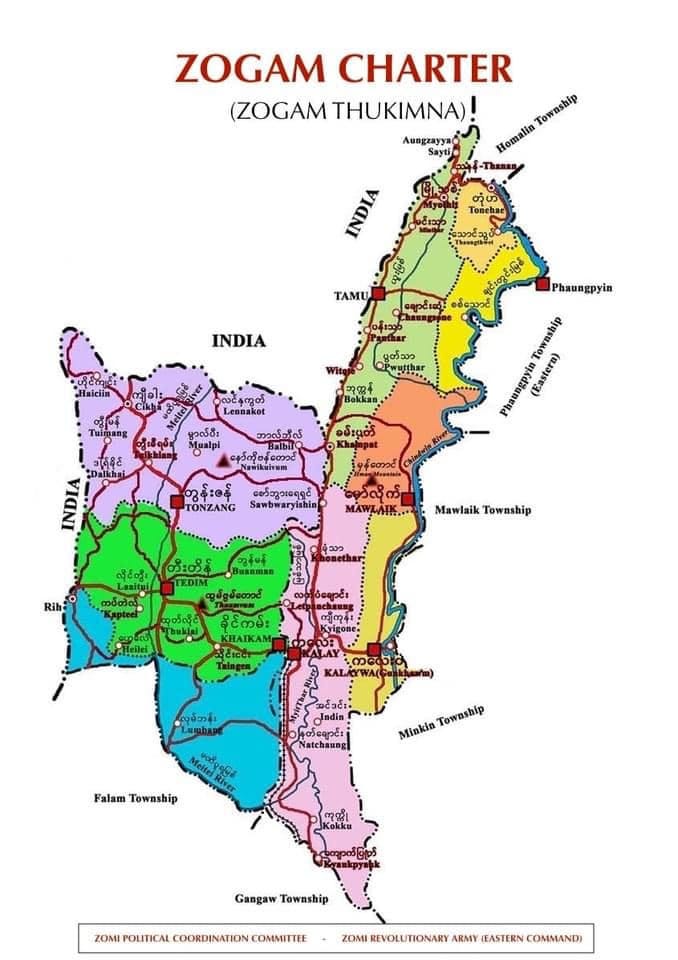
While the central and southern corridors of Chin State are locked in a “Highland Duel” between rival revolutionary patrons, the northern districts of Tedim, Tonzang, and the Kabaw Valley have consolidated into what we now categorize as the Northern Fortress. This is not merely a military holdout; it is the operationalization of a decades-old dream of Zomi Statehood.
I. The Zogam Charter: From Kuala Lumpur to the Frontline
The current political rigidity of the Zomi Political Coordination Committee (ZPCC) is rooted in the 2019 Zogam Charter. Adopted at the Zomi International Conference in Malaysia, this charter reinforced the Zomi identity as a nucleus—independent of the “Chin” umbrella—and designated the Zomi Revolutionary Army (ZRA-EC) as its primary protector.
· The Transition: Post-2021, the movement shifted from international advocacy to tactical survival. The ZPCC was formed to facilitate a resistance that is uniquely non-confrontational with the SAC (State Administration Council) while being highly defensive against incursions from the South.
· The Goal: Internal autonomy within Myanmar, comprising the Tedim district and the majority-Zomi portions of Kalay and Tamu districts.
II. The “Third Space” and Exclusive Governance
The April 19, 2026, declaration of Exclusive Sovereignty is a definitive departure from the NUG/Chin-centric dualities. The ZPCC has established a “No External Party” mandate, effectively creating a sovereign “Third Space.”
· Zogam GAD: Governance is now funneled through the Zogam General Administration Department. Unlike the administrative collapse seen in contested southern towns, the Zogam GAD prioritizes Zomi linguistic and land rights as the foundational pillars of their proto-state.
· Tactical Neutrality: By avoiding active combat with the Tatmadaw, the ZRA-EC preserves its strength to act as a deterrent against the Chinland Council (CC) and Chin Brotherhood (CBA), whom they view as existential threats to Zomi self-determination.
III. The Trans-Border Dimension: India’s Northeast Frontier
The Zomi identity is a transnational reality, split by colonial-era boundaries but unified by kinship. New Delhi’s management of this frontier is now at a critical junction.
Mizoram: The Unity vs. Autonomy Balance
In Mizoram, the Zomi presence is influential, particularly in the northeast.
· Sialkal Range Development Council: This represents a “soft approach” to development. While the Mizo sentiment for “Mizo Unity” remains the priority, the current administration under Chief Minister Lalduhoma appears to favor a policy of integration (Zo nahthlak) rather than suppression.
· Outlook: A separate Zomi district within Mizoram is unlikely in the immediate future; social harmony remains the local priority.
Manipur: The “Separate Administration” Imperative
Manipur remains a powder keg of identity-based conflict (Meitei, Naga, and the Kuki-Zomi-Hmar kindreds).
· The Kinship Paradox: While Kuki and Zomi are of the same kindred, political differences have led to historical division.
· New Delhi’s Options:
1. Option A (UT/Statehood): Granting a “Separate Administration” for Kuki, Zomi, and Hmar into a single unit.
2. Option B (Integration): Integrating the Naga areas into Nagaland and the Kuki-Zomi-Hmar areas into a “Greater Mizoram.”
· Analyst’s Warning: Continued delay from New Delhi will likely result in further tribal attrition and a complete breakdown of the Northeast frontier.
IV. The Road to Statehood: The “Wa Model” in the West?
The Zomi dream of statehood within Myanmar faces its steepest hurdles from the Chin kindred in the south. However, the Zomi possess the three essential ingredients for constitutional recognition: Political Infrastructure (ZNP), Population, and Territory.
· The Naypyidaw Strategy: The ZPCC may seek a path similar to the Wa State or Pa-O (PNO) special zones—gaining favorable status from Naypyidaw by maintaining regional stability.
·Long-term Outlook: A sustainable solution requires a rare alignment between Naypyidaw and New Delhi. The Zomi are positioning themselves as a buffer—a stable, autonomous entity that can manage the border more effectively than a fractured Chin coalition.
Strategic Verdict: The Zomi movement has effectively opted out of the broader Myanmar civil war to build a localized peace. Their “Northern Fortress” is a reality that diplomats and regional observers can no longer ignore.