
Date: April 16, 2026
Location: Kohima-Mon-Phek Axis
Status: Fragile Truce / Strategic Re-alignment
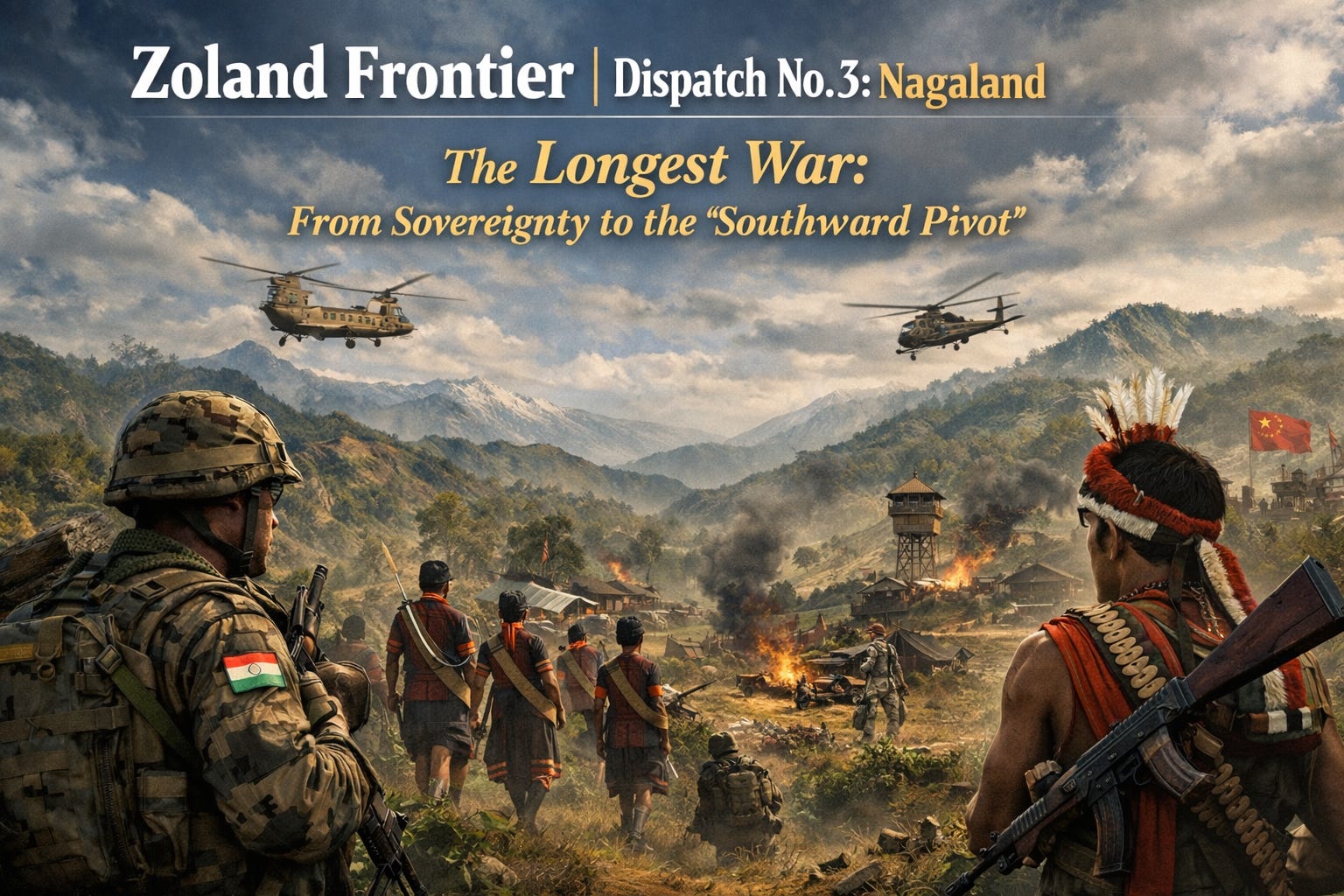
Nagaland occupies a unique space in the Indo-Myanmar frontier. While Mizoram is defined by kinship-refugee dynamics and Manipur by inter-ethnic collapse, Nagaland is defined by the Naga National Movement—the oldest insurgency in South Asia. In 2026, the 215-km border with Myanmar’s Sagaing Region and Kachin State is no longer just a line on a map; it is the “Trans-Naga” bridge.
I. The Trans-Naga Identity: Defying the 1953 Line
The Naga people are divided by a border drawn in 1953 without their consent. On the Indian side lies the state of Nagaland; on the Myanmar side lies the Naga Self-Administered Zone (SAZ) in Sagaing.
The NSCN-K Factor: The Myanmar-based faction of the National Socialist Council of Nagalim (NSCN-K) maintains its headquarters in the Taga region of Myanmar. For decades, this has been the “safe haven” for various Northeast Indian insurgent groups.
The 2026 Shift: As the Myanmar military (Junta) loses control of the Sagaing Region to the People’s Defence Forces (PDFs), the NSCN-K is facing a dilemma: remain neutral or join the resistance. Our intelligence suggests the younger cadres are increasingly sympathetic to the anti-junta cause, complicating New Delhi’s “Act East” diplomacy.
II. Mon District: The Gateway to the “Unknown”
The Mon District of Nagaland is the strategic focal point. Here, the Konyak Nagas live in villages like Longwa, where the international border literally bisects the Chief’s (Angh’s) house.
Security Porosity: Despite the official scrapping of the Free Movement Regime (FMR), the terrain in Mon is so rugged that enforcement is nearly impossible.
The Arms “Bazaar”: With the collapse of central authority in Northwest Myanmar, small arms—ranging from junta-issued rifles to Chinese-made weaponry—are trickling into Nagaland’s “Gray Markets.” This has led to a 15% increase in local weapon seizures by the Assam Rifles in the first quarter of 2026.
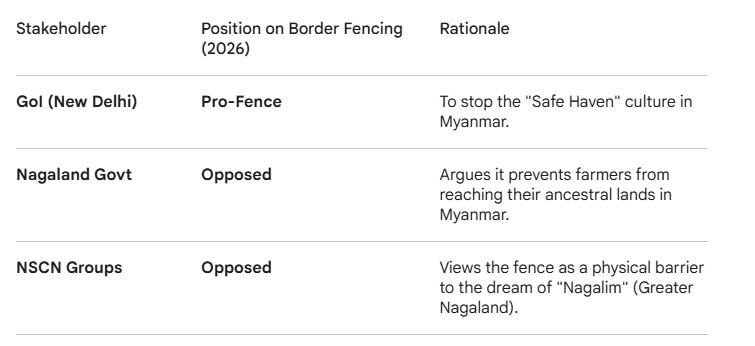
III. The Peace Process vs. The Border Fence
The “Framework Agreement” signed in 2015 between the Government of India and the NSCN-IM remains the elephant in the room.
IV. Strategic Outlook: The “Kachin” Connection
As we look toward the 2026-2027 cycle, the most critical development is the Naga-Kachin Alliance. The Kachin Independence Army (KIA) in Myanmar has historically trained Naga rebels. If the KIA and the Myanmar Nagas form a unified front against the junta, Nagaland could become a logistical corridor for the most powerful resistance forces in Southeast Asia.
Key Risks for Analysts:
Ceasefire Breakdown: If the Naga political solution remains unsigned by late 2026, frustrated youth may cross back into Myanmar to join the fighting, ending the long-standing “Suspension of Operations.”
The “Act East” Bottleneck: The road from Kohima to Myanmar via Avangkhu (Phek District) is intended to be a trade hub. Currently, it is a military supply line. Trade cannot flourish until the “Trans-Naga” political question is settled.
Investigative Note: The Nagaland “Gray Zone”
1. The Camp Hebron Paradox (The “State within a State”)
As of April 14, 2026, the NSCN-IM continues to maintain its headquarters at Camp Hebron, near Dimapur. Investigative journalists must watch the “Fruitful but Silent” nature of recent talks.
The Lead: For the first time in history, India’s interlocutor (A.K. Mishra) held formal talks inside the rebel headquarters this month.
The Conflict: Despite these “fruitful” optics, the core demand for a Separate Naga Flag and Constitution remains an immovable object. The investigation here is: How long can “fruitful silence” hold back a youth population that sees no economic dividend from the 1997 ceasefire?
2. The “Yung Aung” Resurgence in Myanmar
While the Indian Nagas talk peace, the NSCN-K (Yung Aung faction) in Myanmar is actively kinetic.
The March 26 Attack: Just weeks ago, NSCN-K-YA claimed responsibility for an attack on the Namgoi–Pangsau Road that killed three Assam Rifles personnel.
The Narrative: Their “Ministry of Information” explicitly cited the “illegal fencing” as their casus belli. This suggests that the fence is not just a barrier to civilians; it is a tactical target that is unifying disparate insurgent groups against a common infrastructure.
3. The “Narco-Precursor” Loop
Investigative reports from late 2025 and early 2026 (including Enforcement Directorate raids) have uncovered a sophisticated “Circular Smuggling” route.
The Flow: Precursors (pseudoephedrine and caffeine anhydrous) flow out of India (via Assam and Nagaland) into the Sagaing “kitchens” of Myanmar.
The Return: High-grade “Yaba” tablets and heroin flow back into Nagaland.
The Smoking Gun: Myanmar nationals are reportedly using stolen or “borrowed” Indian GST credentials to procure raw chemicals legally in India before diverting them to the border. This points to a deep level of administrative corruption or oversight failure in the border trade permits.
4. The Longwa “Schism”
In the Konyak Naga heartland (Mon District), the village of Longwa is the bellwether for human rights.
The Investigation: Look into the “Chief’s Angh.” Traditionally, he ruled over villages in both nations. With the scrap of the Free Movement Regime (FMR) in 2025/2026, the village is literally being sliced.
The Social Cost: Investigative field notes show that farmers who own land “across the house” in Myanmar are now being treated as “infiltrators” by patrolling forces. This is creating a radicalized border citizenry who feel their traditional sovereignty is being traded for “national security” that doesn’t include them.
If you find this analysis valuable, consider supporting my work so I can keep these deep dives coming: https://buymeacoffee.com/zolandfrontier