
Date: June 24, 2026
Perspective: Regional Security Analysis
Status: Naval Besiegement / Geopolitical Megaprojects / “Way of Rakhita”
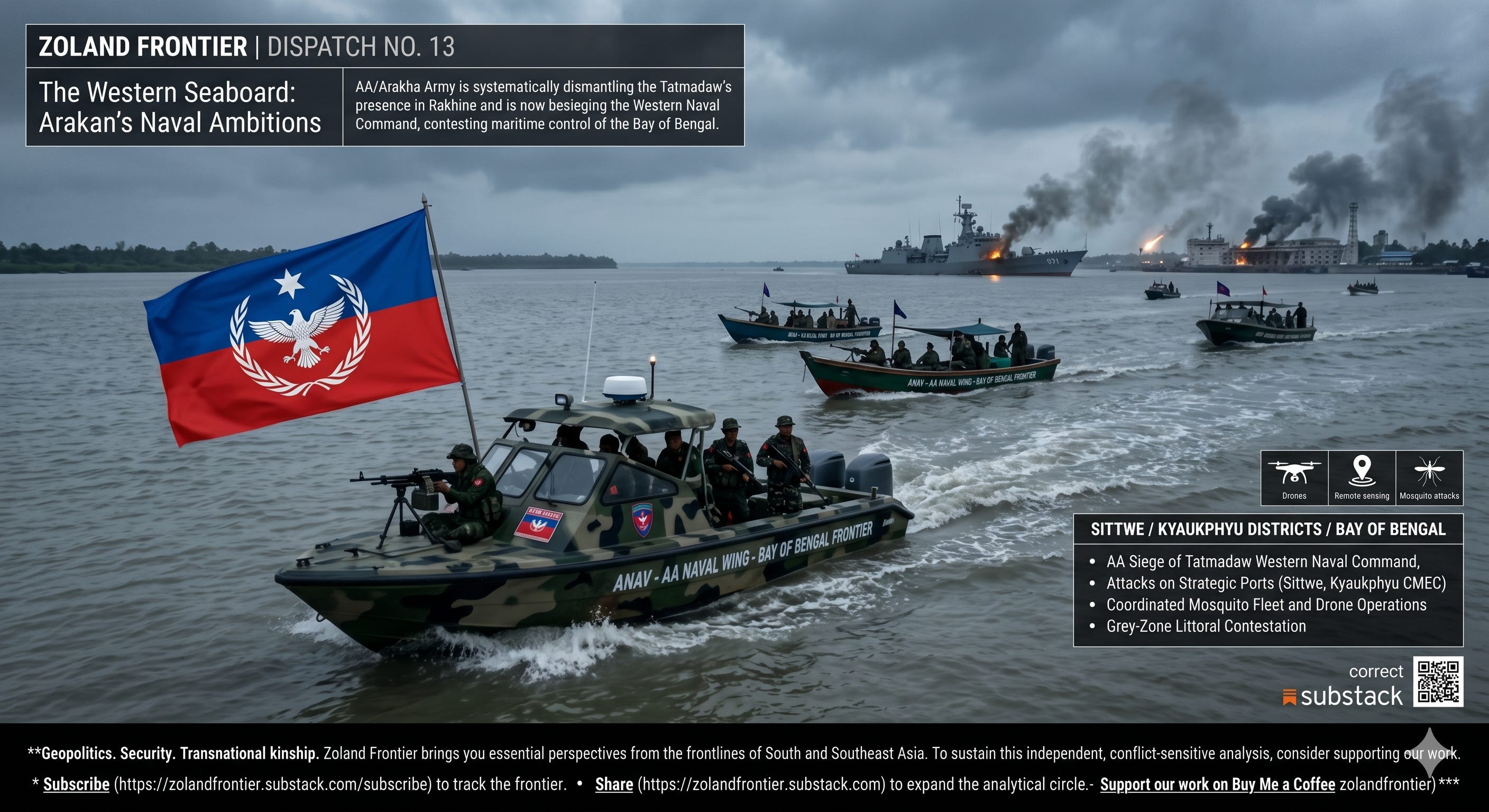
As the Eastern and Southern corridors evolve, the Western Seaboard in Rakhine (Arakan) State presents the most conventionally advanced theater of the conflict. The Arakan Army (AA)—recently rebranded as the Arakha Army to project inclusive regional governance—has systematically dismantled the ground presence of the Tatmadaw (Myanmar Armed Forces). Controlling 14 of Rakhine’s 17 townships, the AA has effectively pushed the military to the edge of the sea.
Now, the conflict has shifted from the jungle and rural plains to the estuaries, deep-sea ports, and the open waters of the Bay of Bengal. The AA is no longer just a formidable infantry force; it is actively besieging the Tatmadaw’s Western Naval Command.
I. The Besiegement of the Western Naval Command
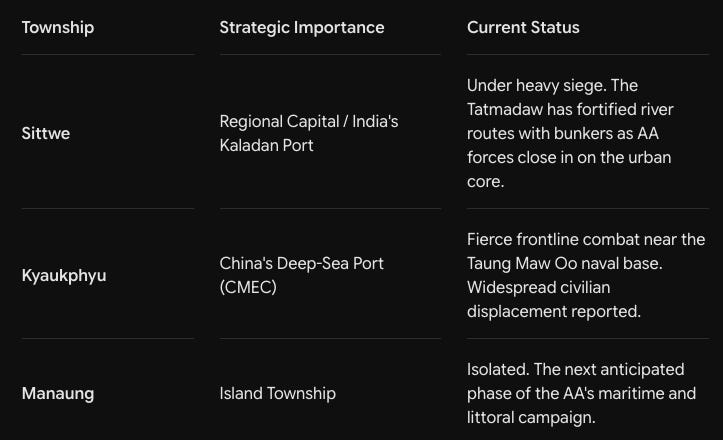
With overland supply routes severed, the Tatmadaw relies entirely on the Myanmar Navy to resupply and defend its remaining urban strongholds in Sittwe, Kyaukphyu, and Manaung. In response, the AA has launched a relentless campaign to neutralize this naval superiority.
Sittwe and the Kaladan River: Intense fighting has erupted just north of the regional capital. AA forces are systematically attacking the Shwe Min Gan naval support base on the Kaladan River. Artillery and drone strikes have successfully hit naval vessels, forcing regime warships to remain offshore and severely limiting their presence in the river network.
Kyaukphyu’s Taung Maw Oo Base: Further south, heavy clashes are ongoing near the Taung Maw Oo naval base in Kyaukphyu Township. The military has been forced to evacuate officers’ families by boat while relying on offshore naval bombardment and aerial drone strikes to hold the perimeter.
II. Geopolitical Megaprojects: The Dragon and the Elephant
The battle for the western seaboard is not merely a domestic struggle; it is taking place atop multi-billion-dollar geopolitical fault lines. For both China and India, Rakhine is the strategic corridor to the Indian Ocean.
China’s CMEC and Kyaukphyu: The fierce fighting in Kyaukphyu directly threatens the crown jewel of the China-Myanmar Economic Corridor (CMEC): the Kyaukphyu Deep-Sea Port and Special Economic Zone.
India’s Kaladan Project: To the north, the siege of Sittwe complicates India’s Kaladan Multi-Modal Transit Transport project, which relies on the city’s port to connect India’s landlocked Northeast to the sea.
The New Landlord: As the Tatmadaw’s territorial control shrinks, the AA has emerged as the de facto sovereign of these territories. Regional powers can no longer rely solely on Naypyitaw; they are being forced to quietly engage with the AA to secure their strategic investments.
III. The Ethnic Complexities and Demographic Friction
While the AA projects overwhelming military strength, the demographic and social landscape in northern Rakhine remains highly volatile.
Divide and Rule: The military regime has attempted to exploit ethnic fault lines, controversially conscripting displaced Rohingya to fight against the AA or utilizing proxy militias to stir communal tensions.
Humanitarian Concerns: The intensification of fighting has led to massive displacement. The AA’s state-building efforts under the “Way of Rakhita” face heavy international scrutiny, with human rights organizations raising severe alarms regarding the safety of Rohingya communities caught in the crossfire.
IV. Conflict Situation Matrix: The Final Three Townships
V. Concluding Analyst Note: A New Maritime Power
AA Commander-in-Chief Twan Mrat Naing has publicly vowed to capture these remaining townships by 2027. If the Arakan Army successfully neutralizes the Tatmadaw’s Western Naval Command, they will achieve complete territorial hegemony over the western seaboard. This will officially transform the group from a land-based ethnic insurgency into a quasi-state maritime power on the Bay of Bengal, fundamentally rewriting the security architecture of the Indo-Pacific.
Geopolitics. Security. Transnational kinship. Zoland Frontier brings you essential perspectives from the frontlines of South and Southeast Asia. To sustain this independent, conflict-sensitive analysis, consider supporting our work.