
Date: April 21, 2026
Perspective: Senior Regional Analyst
Status: High-Risk Fragmentation / Aerial Attrition
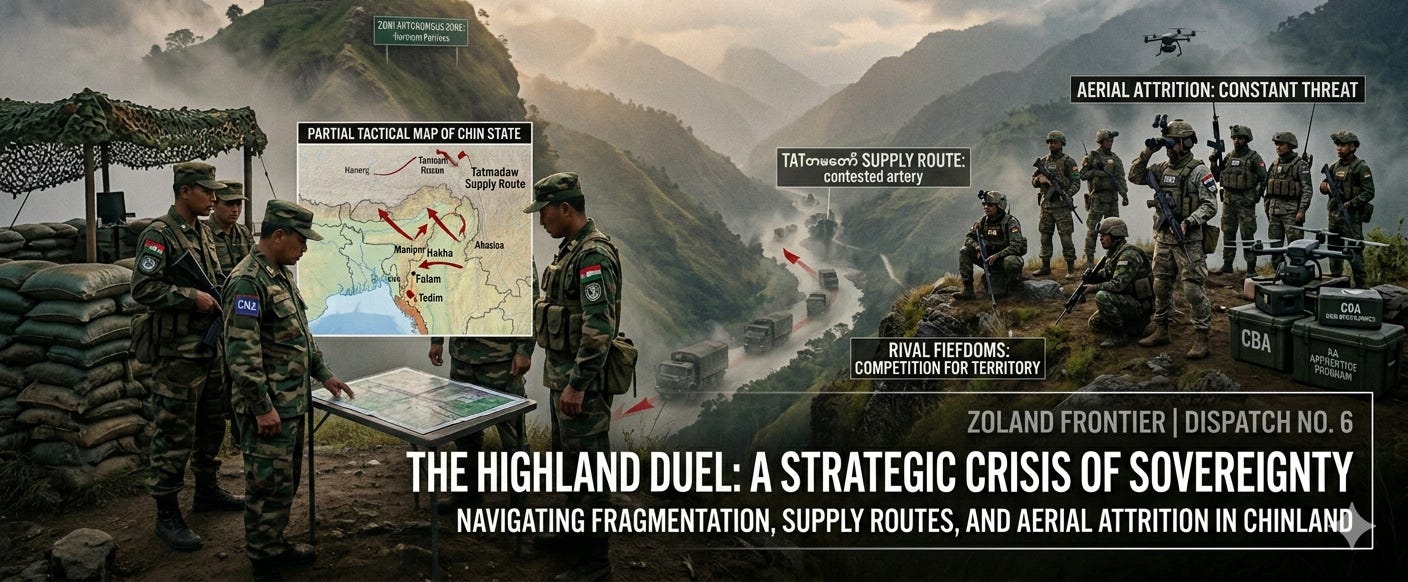
I. The Fracture: Rival Polarities in Chinland
The unity previously sought under the Interim Chin National Consultative Council (ICNCC) has fractured. In its place, two rival centers of gravity have emerged, competing for dominance in central Chinland.
The Chinland Council (CC/CNA): Pushing for a unified Chinland, the CC has prioritized institutional dominance. However, the internal friction following the recapture of Falam and Rih from the CNDF has severely damaged trust across the resistance spectrum.
The Chin Brotherhood Alliance (CBA): While their unified administrative plan has led to some success, these emerging governance structures are under constant threat. Heavy and sustained aerial attacks by the Tatmadaw have made it nearly impossible to maintain a stable, visible administration in captured urban hubs.
II. The Strategic Crisis: Supply Routes and Attrition
The revolution faces a “Paradox of Capture.” While towns are liberated, the inability to permanently sever the Tatmadaw’s primary supply routes—specifically the Kalay-Khaikam-Taingen lifeline—means the junta can continue to funnel reinforcements into the highlands. Without controlling these veins, urban victories remain under constant siege.
III. The Northern Fortress: Zomi Identity Formation
On April 19, 2026, the Zomi Political Coordination Council (ZPCC) and the ZRA-Eastern Command signaled a definitive departure from the Chin-centric dualities.
Exclusive Sovereignty: Asserting absolute authority over Zogam, the ZPCC has issued a “No External Party” mandate, rejecting the administrative or military interference of the CC, CBA, or NUG within their ancestral lands.
Zogam GAD: Governance in the north is being funneled through the Zogam General Administration Department, prioritizing Zomi linguistic and land rights as a sovereign “Third Space.”
IV. Humanitarian Toll and Civilian Resentment
The cost of this institutional rivalry is falling on the civilian population. Reports of forced drives for manpower in villages like Laitui, Tuivial, Buan, and Dimpi have seen youths taken at gunpoint, often during sensitive community events such as funerals. This behavior has begun to shift the previous revolutionary fervor into a growing sense of resentment toward the armed factions.
V. The Tatmadaw’s Gradual Advance
Exploiting the friction between the CC and CBA, the Tatmadaw is advancing toward Falam. Using jungle trails to avoid detection and utilizing drone reconnaissance, approximately 800 troops are closing in.
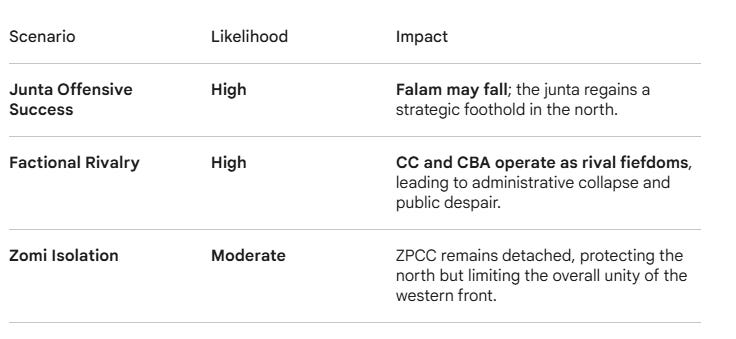
Strategic Verdict: The Chin revolution is at a crossroads. The transition from liberation to stable governance is being thwarted by both internal rivalry and the junta’s aerial superiority. Without a unified command and a joint strategy to hold the Kalay-Khaikam-Taingen route, the gains of the last year remain in jeopardy.
Concluding Note: The Price of Disunity
The Chin revolution is currently its own greatest enemy. The transition from the “Arakan Model” of consolidated sovereignty to the “Chin Model” of fragmented rivalry is a warning to all regional observers.
If Falam falls back to the military council due to internal animosities, it will be an “indelible black stain” on the history of the movement. For diplomats and aid workers, the priority must shift from supporting “the resistance” as a monolith to facilitating internal political dialogue. Without a unified military command and a shared administrative framework for liberated towns, the “revolutionary spirit” will be crushed not by junta boots, but by the weight of organizational self-interest.
If you find this analysis valuable, consider supporting our work so we can keep these deep dives coming: https://buymeacoffee.com/zolandfrontier