
Date: August 14, 2026
Perspective: Regional Security Analysis
Status: Cartographic Anxieties / Institutional Friction / Historical Revisionism
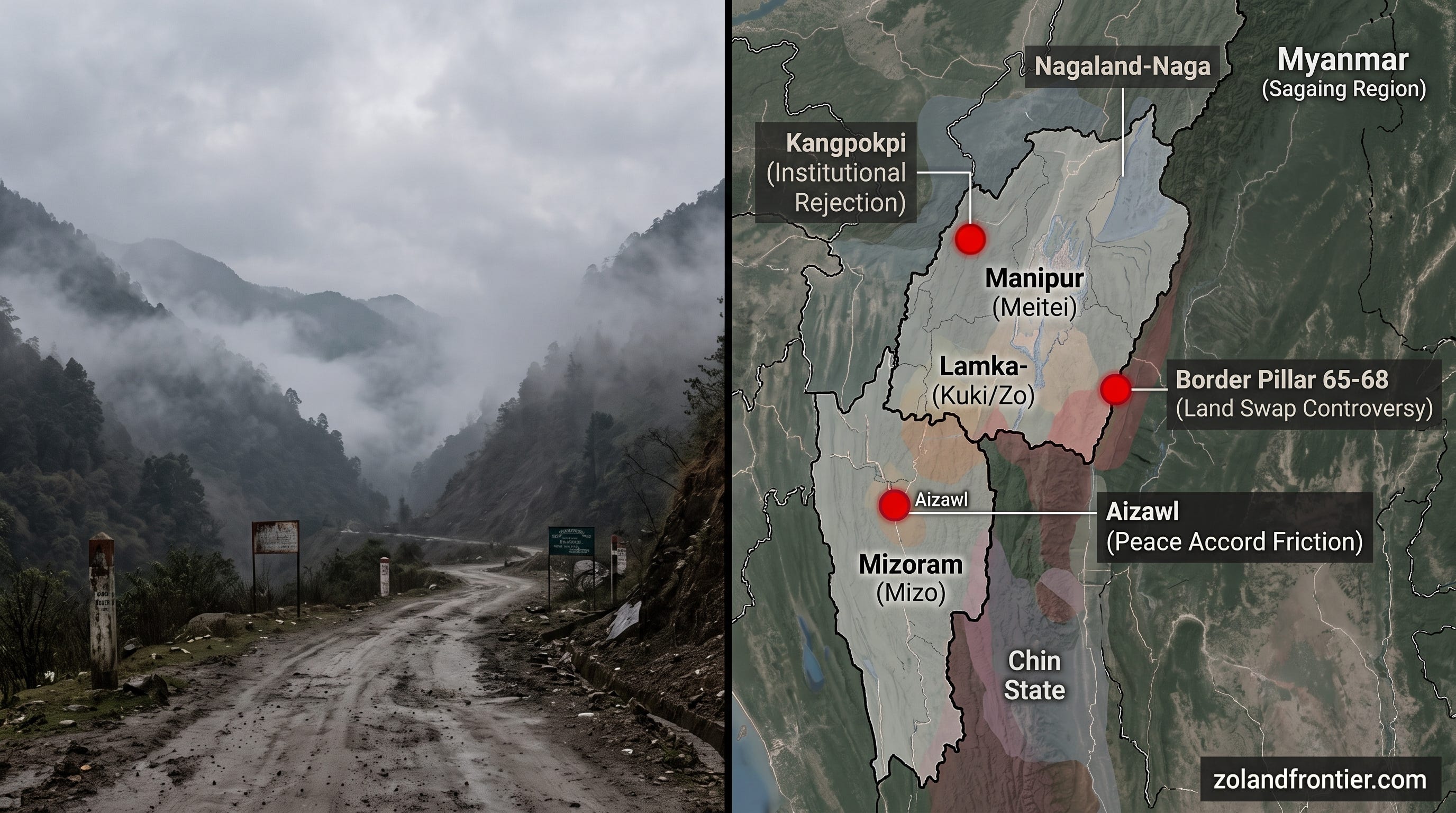
Following our previous analysis on the balkanization of Manipur’s governance grid, the geopolitical fault lines across the tri-border region continue to deepen. Recent developments highlight a potent mix of territorial insecurity along the Indo-Myanmar border, a complete rejection of state authority in the highland buffer zones, and a fierce political controversy in Mizoram regarding the historical foundations of its autonomy.
I. Cartographic Anxieties: The Border Pillar 65-68 “Land Swap”
The ongoing infrastructure push to solidify the Indo-Myanmar Border (IMB) has hit a new flashpoint regarding territorial integrity. According to a July 17, 2026 report from The Diplomat, an internal Indian Government document revealed that New Delhi and Naypyidaw are considering a final demarcation that could involve a land swap.
The Molcham Sector: The proposed adjustment focuses on an approximately 2.75 to 2.8-kilometer stretch between Border Pillars 65 and 68, located in Manipur’s Chandel district adjacent to the Kabaw Valley.
The Scope of Transfer: The internal proposal suggests that approximately 3.5 square kilometers (1.4 square miles) of land could be involved in the exchange.
Frontier Paranoia: While the Ministry of External Affairs has acknowledged ongoing discussions for unresolved sections, there has been no finalized agreement or cabinet approval. Nonetheless, this news has severely amplified anxieties among border communities. Amidst the intense post-2023 ethnic conflict, there is a profound fear that conceding even a marginal sliver of territory will establish a dangerous precedent for future cartographic subversions along the militarized frontier.
II. The Fractured Buffer: Rejecting State Authority in Kangpokpi
The inability of the state apparatus to re-establish administrative legitimacy in the Zo kindred hills was starkly demonstrated this past week. While the Chief Minister has attempted to project a restoration of normalcy through localized engagements, the systemic divide remains absolute.
The Kangpokpi Visit: Manipur Chief Minister Y. Khemchand Singh recently visited Kangpokpi at the invitation of certain district-level civil society organizations.
Institutional Rejection: On August 9, 2026, the Kuki Inpi Manipur (KIM)—the apex body of the Kuki tribes—issued a public statement categorically rejecting the Chief Minister’s visit. KIM clarified that it was neither consulted nor a party to the engagement, emphasizing that isolated interactions by local groups do not represent the collective mandate of the Kuki people.
The Stalled Political Track: KIM strongly objected to the visit specifically because of the community’s ongoing foundational demand for a “Separate Administration,” viewing the Chief Minister’s localized engagements as attempts to dilute and undermine their political aspirations for temporary political expediency.
III. Historical Friction in Mizoram: The Peace Accord Controversy
While Manipur grapples with a collapsed state apparatus, neighboring Mizoram is facing severe internal political friction over the interpretation of its foundational peace document. Chief Minister Lalduhoma has ignited a major controversy that strikes at the heart of Mizo identity and autonomy.
Diminishing the Accord: During an address to students at the Mizoram Law College on July 31, 2026, Chief Minister Lalduhoma claimed that the term “Mizoram Accord” was technically inaccurate. He argued that the 1986 agreement was merely signed between the Union Ministry of Home Affairs and “one political organisation” (the Mizo National Front), rather than between the Government of India and the state of Mizoram. Furthermore, he referred to the historic document as a “Memorandum of Agreement” and a “Memorandum of Understanding,” rather than its official title, the “Memorandum of Settlement”.
The Inner Line Permit (ILP) Dispute: Exacerbating the tension, the Chief Minister suggested that the continuation of the Inner Line Permit (ILP) ultimately rests with the Centre, which has the authority to revoke the system. He cautioned that the permit must be enforced with “reasonable restraint” to avoid being struck down by courts.
The Ultimatum: These statements were viewed as deeply insulting to the legacy of the insurgency. Former MNA fighters and the opposition MNF party accused Lalduhoma of belittling the hard-won safeguards achieved through decades of sacrifice. Protesting outside the Chief Minister’s office in traditional black pawndum shawls, the MNF youth wing and leadership issued a strict ultimatum, demanding that Lalduhoma issue a public apology and retract his remarks before August 15.
Geopolitics. Security. Transnational kinship. Zoland Frontier brings you essential perspectives from the frontlines of South and Southeast Asia. To sustain this independent, conflict-sensitive analysis, consider supporting our work.