
Date: April 16, 2026
Location: Imphal Valley / Kangpokpi-Churachandpur Perimeter
Status: Active Conflict / Fragmented Governance
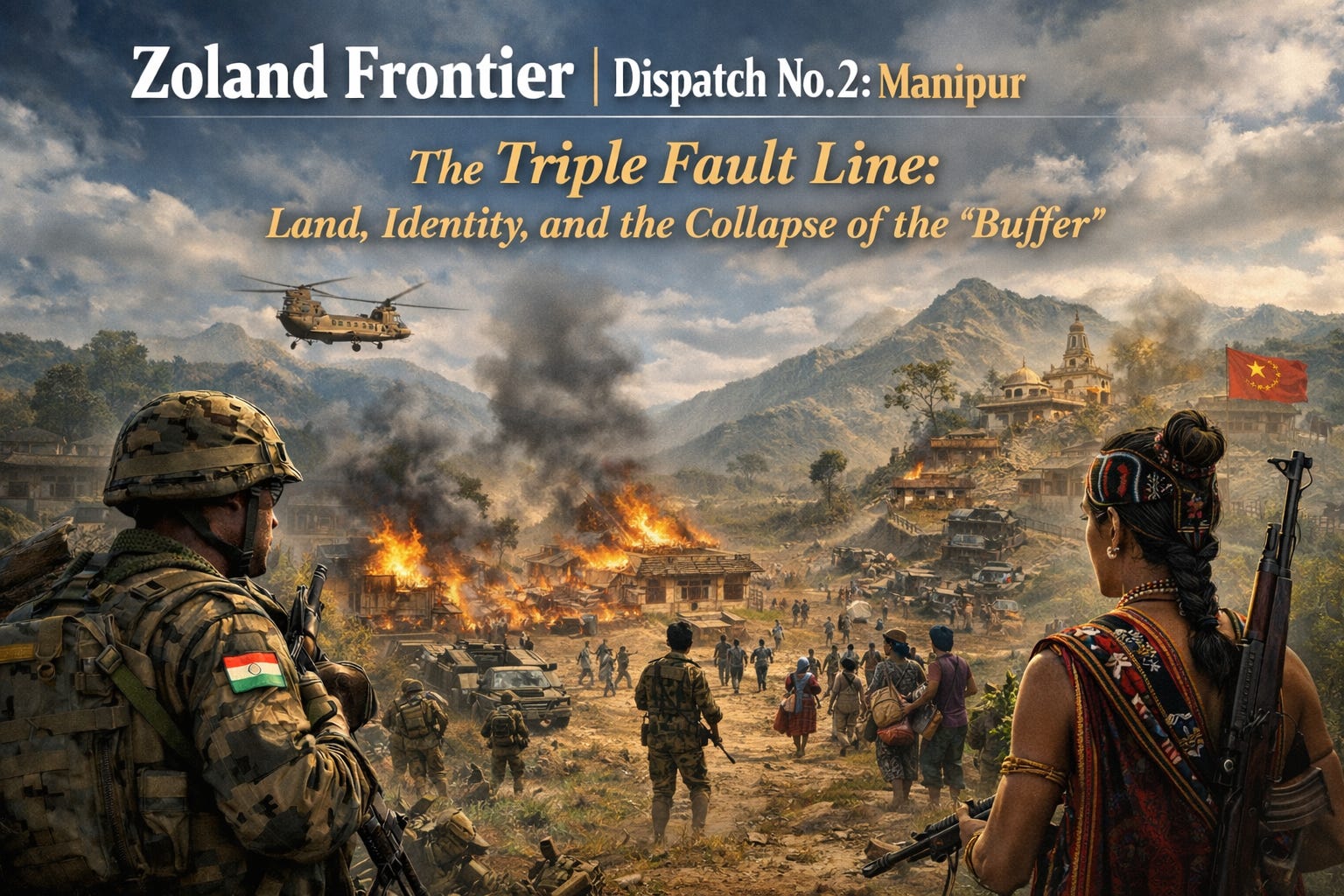
While our last dispatch looked at the “Kinship Corridor” of Mizoram, the situation in Manipur is a far more volatile anatomy of internal collapse. As of April 2026, Manipur is no longer a unified administrative entity; it is a collection of ethno-political islands separated by “Buffer Zones” patrolled by central paramilitary forces.
The crisis is not merely a spillover from Myanmar; it is a centuries-old contest over land, hierarchy, and survival that has been weaponized by modern politics.
I. The Three-Way Friction: A Fragile Geometry
The conflict in Manipur is often simplified as Meitei vs. Kuki, but by early 2026, the Naga factor has re-emerged as the critical third vertex.
Meitei vs. Kuki-Zo: The primary frontline. The Meitei (Valley) demand for Scheduled Tribe (ST) status—and the subsequent tribal resistance—triggered the 2023 explosion. In 2026, this has evolved into a “war of drones and projectiles,” with recent bomb attacks in Bishnupur (April 7, 2026) killing civilians and reigniting valley-wide protests.
Kuki-Zo vs. Naga: Historically antagonistic (notably during the 1990s), relations have soured again in 2026. Flare-ups in districts like Ukhrul have led to the evacuation of Kuki students, as Nagas increasingly view Kuki territorial claims for “Separate Administration” as an encroachment on ancestral Naga lands.
Meitei vs. Naga: Currently a “cold peace.” While both live together in Imphal, the Nagas remain wary of Meitei majoritarianism, even as they oppose Kuki expansionism.
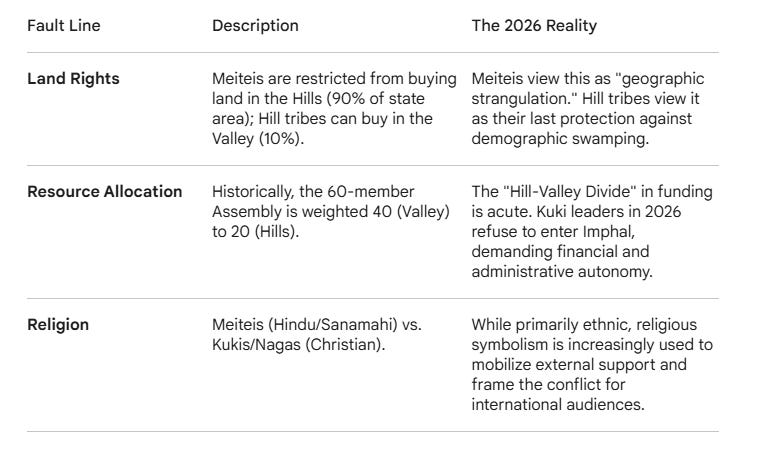
II. The Structural Fault Lines
To understand the intractability of Manipur, one must look at the Valley vs. Hills binary that defines every aspect of life:
III. The “Border Within”: Security & Governance
As of February 2024, a new coalition government was formed under Chief Minister Yumnam Khemchand Singh (Meitei), with Nemcha Kipgen (Kuki-Zo) and Losii Dikho (Naga) as Deputy CMs. However, this is a government in name only.
Virtual Governance: Deputy CM Nemcha Kipgen reportedly takes oaths and conducts business from New Delhi or Kangpokpi, as it is physically unsafe for her to enter the Meitei-dominated Imphal Valley.
The Drone War: Investigative reports indicate a shift in tactics. Armed groups are now utilizing commercial drones for reconnaissance and “drop-and-run” explosives, a technical leap likely influenced by the resistance tactics seen across the border in Myanmar’s Sagaing region.
The Narcoterriorism Narrative: The state government continues to frame the Kuki resistance as “illegal immigrants” and “narcoterrorists” linked to poppy cultivation. In reality, poppy is a symptom of the broken economy and the lack of alternative livelihoods in the neglected hill districts.
IV. Strategic Analysis: 2026 & Beyond
For the international community, Manipur is a warning of how “Zomia”—the highland region across South and Southeast Asia—can fracture when state neutrality collapses.
Critical Indicators for Conflict Analysts:
Weapon Proliferation: Over 4,000 weapons looted from police armories in 2023 remain in the hands of civilian “village volunteers.” Disarmament has stalled as both sides view their weapons as their only security.
The NRC Demand: Meitei organizations are pushing for the implementation of a National Register of Citizens (NRC) to identify “infiltrators” from Myanmar. This is the primary political flashpoint for 2026.
The Naga Neutrality: If the Naga insurgent groups (like NSCN-IM) decide to actively intervene to protect their territorial interests against Kuki claims, the conflict will shift from a bilateral ethnic war to a multi-front regional catastrophe.
Investigative Note: Watch the National Highways (NH-2 and NH-37). These are the lifelines of the state. Whoever controls the “gates” at Mao (Naga) or Kangpokpi (Kuki) controls the survival of the Imphal Valley.
Zoland Frontier | Investigative Note: Manipur
The Manipur investigation focuses on the institutional collapse and the technical evolution of a localized civil war.
The “Ghost” Police Armories: The narrative of “looted weapons” (nearly 5,000 firearms) is well-documented, but the investigation into the lack of recovery is more revealing.
The Smoking Gun: Interviews with mid-level police officers suggest that a significant portion of the “loot” was actually a “soft transfer” to ethnic militias (the Arambai Tenggol and Kuki militants) to act as frontline proxies while the state’s official forces remained paralyzed by their own ethnic internal divisions.
The Sagaing Drone Tech Transfer: Manipur is currently a testing ground for cheap, aerial warfare.
The Lead: The drones used in the February 2026 attacks on border villages showed modifications—specifically 3D-printed release mechanisms—identical to those used by the PDF (People’s Defence Forces) in Myanmar’s Sagaing region. This confirms a cross-border technical exchange where insurgent “innovations” in Myanmar are being exported into Indian domestic ethnic strife.
The Poppy-Forestry Nexus: The “War on Drugs” is often used to justify the eviction of Kuki tribes from hill forests.
Satellite imagery and land records indicate that while poppy is indeed being cleared, the reclaimed land is frequently being earmarked for private palm oil plantations and mineral exploration (specifically chromite) rather than forest conservation. This suggests that “environmentalism” is being used as a legal cloak for state-sponsored land grabbing.
If you find this analysis valuable, consider supporting my work so I can keep these deep dives coming: https://buymeacoffee.com/zolandfrontier