
Date: June 27, 2026
Perspective: Regional Security Analysis
Status: Counter-Insurgency / Demographic Engineering / Transnational Containment
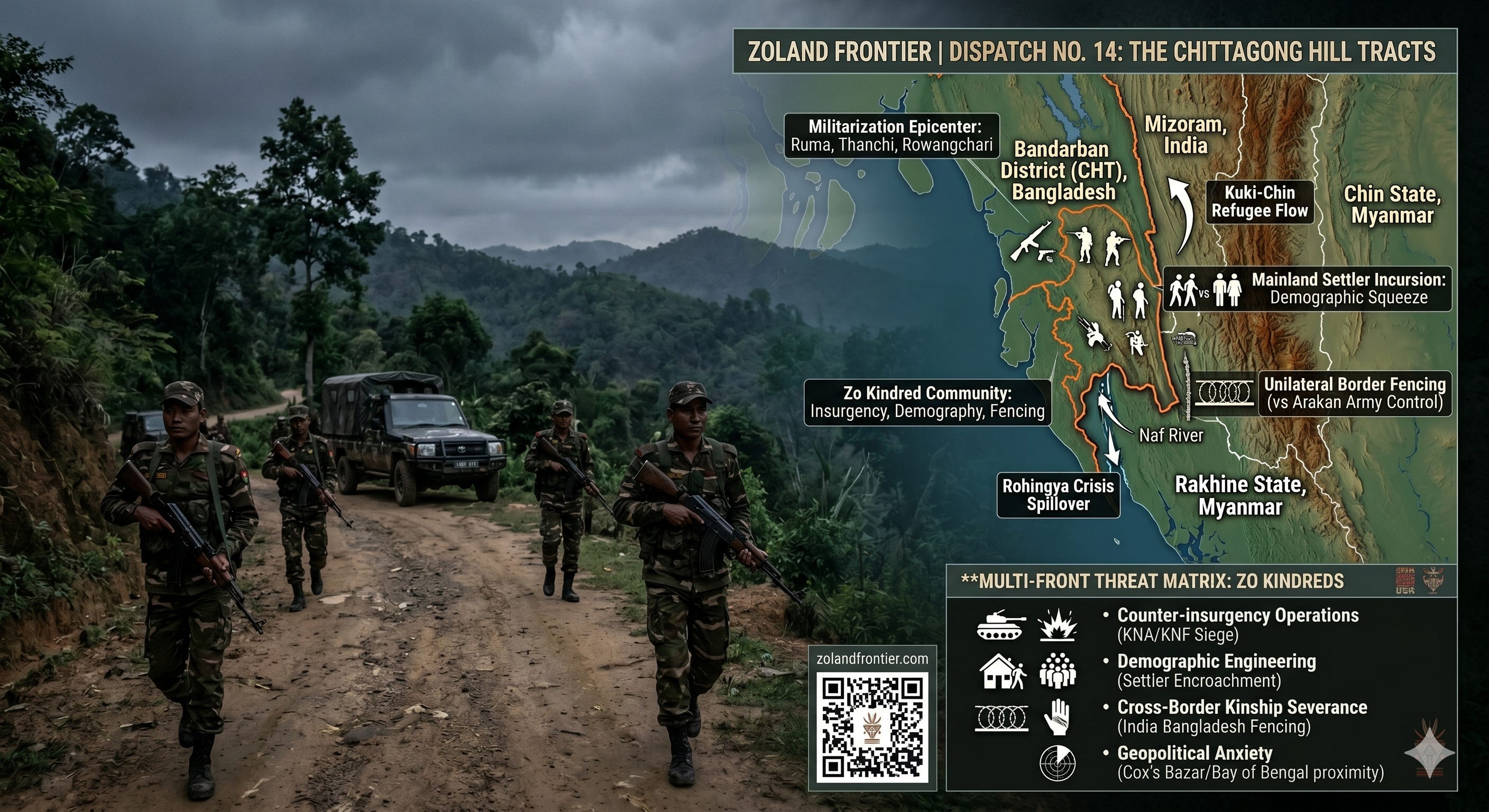
While international attention heavily focuses on the Myanmar civil war, a distinct but deeply interconnected ethno-nationalist conflict continues to boil across the border in the Chittagong Hill Tracts (CHT) of Bangladesh. In the rugged terrains of the Bandarban district, the emergence of the Kuki-Chin National Front (KNF) has fundamentally fractured the historical insurgent landscape. Today, the smaller Zo kindreds (including the Bawm, Lusai, Pangkhua, Khumi, Mro, and Khiang) are fighting for survival against a multi-front threat: state militarization, demographic replacement, and the spillover of transnational crises.
I. The KNF and the Rejection of the Status Quo
Historically, indigenous resistance in the CHT was monopolized by the Parbatya Chattagram Jana Samhati Samiti (PCJSS), which culminated in the 1997 Peace Accord. However, the smaller Kuki-Chin ethnic groups have long felt marginalized by both Dhaka and the Chakma-dominated political forces.
Driven primarily by the Bawm community, the KNF officially declared an armed struggle to secure an autonomous “Kuki-Chin State.” Their audacious daylight bank robberies in Ruma and Thanchi in early 2024 escalated the conflict from a localized grievance into a major national security crisis for Bangladesh, prompting devastating joint-force crackdowns and mass arbitrary arrests that have deeply traumatized the civilian population.
II. The Demographic Squeeze: Settler Incursions
Beyond active combat, the most existential threat to the Zo kindreds is systemic demographic engineering. Over the decades, state-sponsored and organic migration of Bengali settlers from the mainland into the CHT has drastically altered the region’s ethnic composition.
Land Dispossession: Indigenous communities are frequently pushed off their ancestral lands to make way for settler expansion, military camps, and state-backed tourism enterprises.
Economic Marginalization: As settlers dominate local commerce and political administration, the Zo kindreds are increasingly pushed deeper into the remote, unforgiving hill tracts, stripping them of economic agency and agricultural sustainability.
III. The Southern Front: The Rohingya Spillover
To the immediate south and west of Bandarban lies Cox’s Bazar, the epicenter of the world’s largest refugee crisis. The presence of over a million displaced Rohingya has fundamentally destabilized the borderlands, creating severe negative externalities for the indigenous hill tribes.
Resource Competition: The massive humanitarian footprint has led to severe deforestation, water scarcity, and ecological degradation that bleeds into the lower CHT, destroying traditional indigenous livelihoods.
Militarization and Crime: The border region is now a hyper-militarized zone battling the proliferation of Rohingya armed factions (such as ARSA and RSO), the Arakan Army’s cross-border smuggling networks, and the Yaba (methamphetamine) trade. The Zo kindreds find themselves caught in the crossfire of these heavily armed syndicates and state security forces.
IV. The Border Fortress: Bangladesh’s Unilateral Fencing
Adding to the demographic and military pressures is a significant shift in Dhaka’s border policy. Following the Arakan Army’s comprehensive victories in northern Rakhine State, a non-state actor now controls the Myanmar side of the border.
A Unilateral Approach: In June 2026, it was noted by The Diplomat that Bangladesh is increasingly relying on unilateral forms of border management, resulting in the decision to fence its border with Myanmar.
The Containment Trap: This fortified barrier fundamentally alters the dynamics for vulnerable communities. For the Zo kindreds fleeing the militarization in the CHT, and for the Rohingya navigating the crossfire in the south, a unilaterally fenced and heavily guarded frontier further shrinks the already limited avenues for transnational sanctuary into Chin State or Rakhine.
V. Geopolitical Paranoia in the Bay of Bengal
The localized struggles of the CHT are occurring within a broader theater of Indo-Pacific geopolitical anxiety. The proximity of the CHT to the Bay of Bengal has turned the region into a hotbed of strategic paranoia.
The Base Rumors: In recent years, baseless rumors regarding the establishment of a United States military base in Cox’s Bazar or St. Martin’s Island were widely weaponized by political elites in Dhaka to stoke nationalist fervor. While entirely false, these narratives justify the continuous, heavy-handed presence of the Bangladesh Armed Forces across the southern coastal and hill corridors, directly resulting in the tight surveillance and containment of the Zo kindreds.
VI. Concluding Analyst Note: A Transnational Sanctuary Denied
The intense crackdowns by the Bangladesh Army and the demographic pressures of the CHT have forced hundreds of Kuki-Chin refugees to flee across the border into the Indian state of Mizoram. The shared ethnic affinity has prompted the Mizoram government and local civil society to provide shelter, highlighting the transnational nature of the Zo identity. Until the structural grievances of land rights, demographic displacement, and political autonomy are addressed in Dhaka, Bandarban will remain a highly volatile frontier, perpetually threatening the stability of the tri-border region.
Geopolitics. Security. Transnational kinship. Zoland Frontier brings you essential perspectives from the frontlines of South and Southeast Asia. To sustain this independent, conflict-sensitive analysis, consider supporting our work.
Analyst Note: In an upcoming dispatch, we will dedicate a longer, comprehensive analysis to the broader geopolitical and humanitarian implications of the border fencing initiatives, specifically exploring the complex dynamics and rising tensions surrounding the Bangladesh-India border fencing projects.
Evaluating Geopolitical Rumors in the Bay of Bengal This video breaks down the strategic context and geopolitical anxieties surrounding the false rumors of a US military base in the region.