
Date: October 2, 2026
Perspective: Regional Security & Humanitarian
Location: Myanmar | Rakhine State · Malaysia
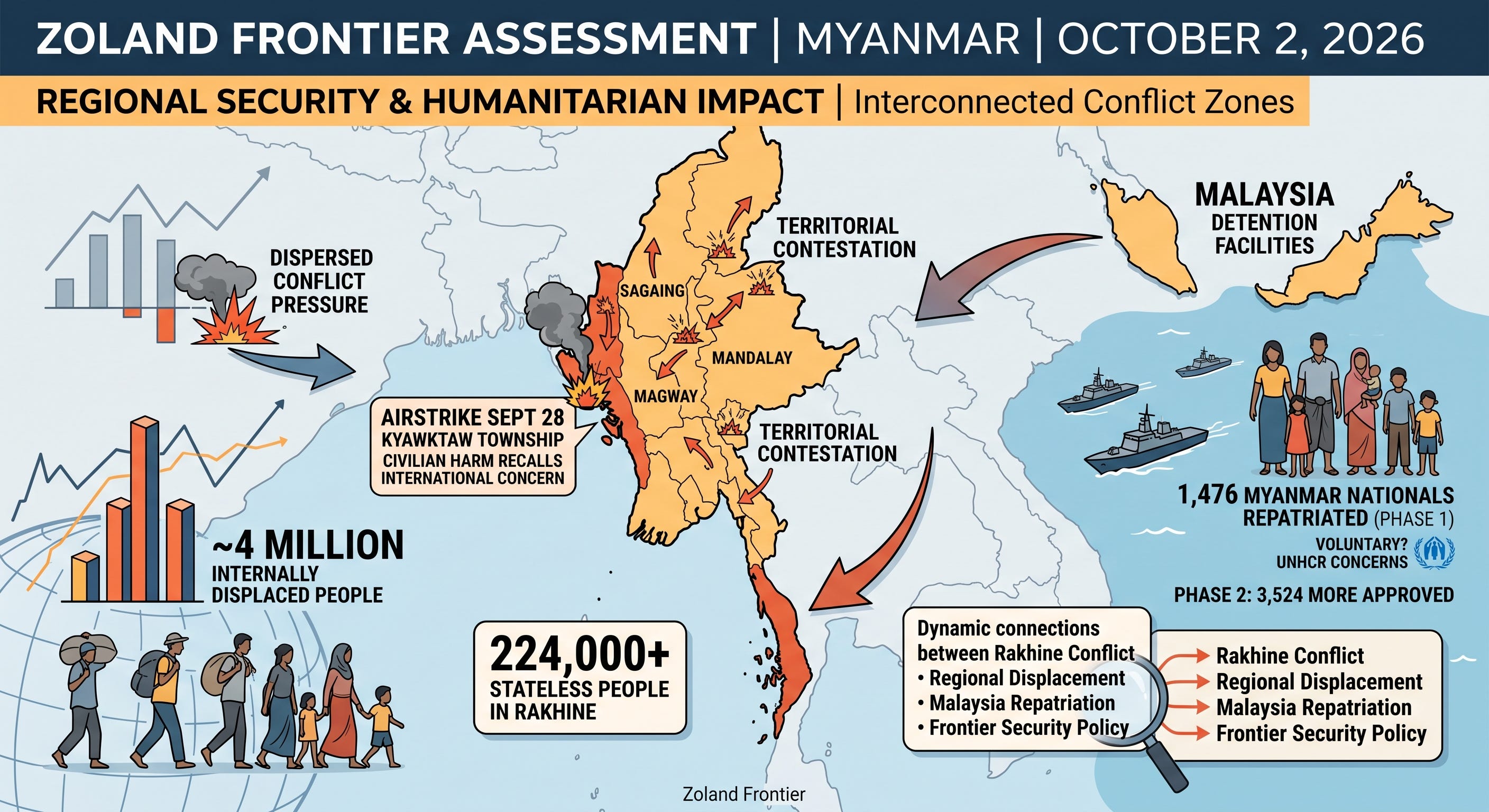
A conflict that continues to reshape the country — and its regional connections
Myanmar enters October with three developments carrying significance beyond their immediate locations: renewed concern over civilian harm in Rakhine State, continuing conflict pressure across the country, and the return of 1,476 Myanmar nationals from Malaysia.
Thanks for reading! Subscribe for free to receive new posts and support my work.
Subscribe
Together, they illustrate a wider pattern: the conflict remains territorial, humanitarian and increasingly transnational at the same time.
Rakhine: civilian protection again at the centre
A reported Myanmar Armed Forces airstrike in Kyauktaw Township, Rakhine State, on 28 September has generated renewed international concern.
Reuters reported that the United Nations was alarmed by reports that approximately 50 people were killed and at least 58 injured. The incident reportedly occurred near a busy market, with several communities affected. The UN called for civilian protection, adherence to international humanitarian law and unrestricted humanitarian access.
The incident comes as conflict between the Myanmar Armed Forces and the Arakan Army continues to shape the security environment across Rakhine and adjoining areas. ACLED’s latest Myanmar analysis, published 1 October, specifically examines recent military airstrikes in Rakhine and describes the state as a major conflict theatre.
For civilians, the significance is straightforward: control of territory does not necessarily translate into civilian security or humanitarian access.
Conflict pressure remains geographically dispersed
Rakhine is only one part of the wider picture.
ACLED’s current Myanmar assessment identifies continued political violence and military operations across multiple parts of the country. Its August outlook assessed that fighting could intensify in central Myanmar, particularly across Sagaing, Magway and Mandalay, as competing forces seek to consolidate territorial positions.
This creates a complex operating environment in which developments in one region can have consequences elsewhere — through displacement, supply routes, armed-group movements, trade corridors and humanitarian access.
The result is less a single front than a network of interconnected conflict zones.
Rakhine and displacement remain inseparable
The security situation also affects the question of whether displaced populations can return.
UNHCR’s current country data records nearly 4 million internally displaced people in Myanmar, with substantial displaced populations across multiple states and regions. Its latest available data also records more than 224,000 displaced stateless people in Rakhine State.
The recent Kyauktaw violence therefore matters beyond the immediate casualty count. It adds another indicator of the security conditions under which any future movement or return of displaced populations would have to be considered.
Malaysia–Myanmar: the conflict crosses the border
On 29 September, Malaysia began the first phase of a repatriation programme involving 1,476 Myanmar nationals detained in Malaysian immigration facilities.
Malaysia describes the programme as voluntary. The group includes 1,370 men, 79 women, 20 boys and seven girls. Three Myanmar naval vessels transported the group, and the vessels entered Myanmar’s territorial waters on 1 October.
UNHCR has expressed concern over the returns. The agency said some of those returned may require international protection and noted that it did not have access to the detainees to assess whether decisions to return were genuinely free and informed.
Malaysia has indicated that the programme could ultimately involve approximately 5,000 people, with a second phase involving 3,524 people already approved.
The issue therefore extends beyond migration administration. It connects Myanmar’s internal conflict with neighbouring states’ refugee, immigration and border-management policies.
The regional picture
Three dynamics deserve continued monitoring:
1. Airpower and civilian exposure
The Kyauktaw incident highlights the continuing importance of air operations in the conflict and their consequences for civilian populations.
2. Fragmented territorial contestation
Conflict remains distributed across multiple regions rather than concentrated around a single battlefield. Current ACLED analysis points particularly to continuing contestation across Rakhine and central Myanmar.
3. Cross-border consequences
The Malaysia repatriations demonstrate how Myanmar’s internal crisis increasingly interacts with neighbouring countries’ migration and protection policies.
Zoland Frontier Assessment
Myanmar’s conflict is increasingly difficult to understand through a purely domestic lens.
The immediate security picture remains fragmented across multiple theatres. At the same time, the consequences move across borders through refugee movements, repatriation programes, humanitarian networks, trade routes and regional security policies.
Rakhine is particularly important in this respect. Its geography connects the conflict to Bangladesh and the Bay of Bengal, while developments there also affect displacement and regional humanitarian policy.
For Zoland Frontier, the key question is therefore not simply where fighting is occurring, but how conflict in one frontier zone changes the political, security and humanitarian environment beyond it.
That is the pattern to watch as October develops.
Zoland Frontier
Geopolitics. Security. Transnational kinship.
Zoland Frontier brings you essential perspectives from the frontlines of South and Southeast Asia. To sustain this independent, conflict-sensitive analysis, consider supporting our work.