
Date: May 9, 2026
Perspective: Senior Regional Analyst
Focus: Environmental Geopolitics, Ethnic Polarity, and the Naga “Buffer”
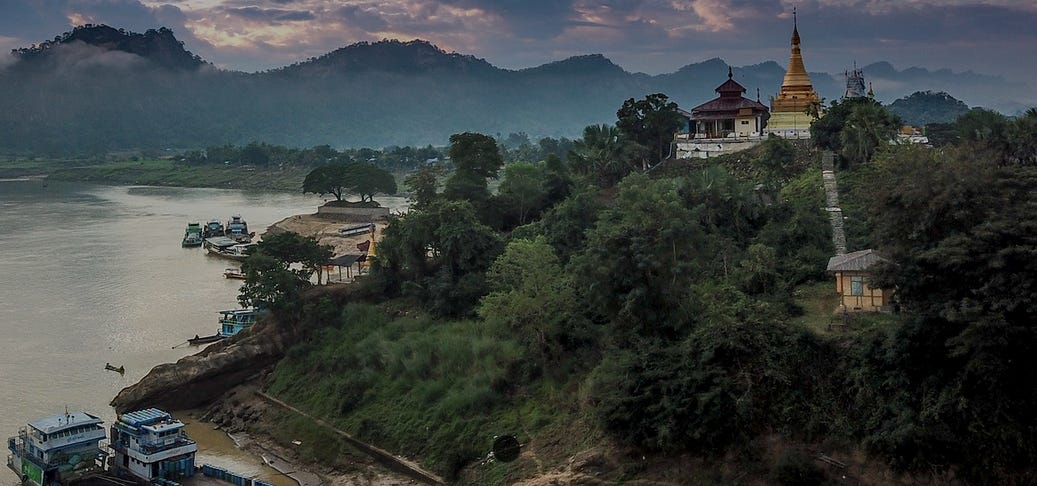
While international attention remains fixed on the heavy urban combat of Central Myanmar, the Upper Chindwin—a region of pristine biodiversity and colonial-era administrative relics—has become a quiet but critical theater of fragmented sovereignty. Stretching from the Chin Hills in the west to the Naga Hills in the north, this region serves as a strategic “land-bridge” for transnational insurgencies and a contested resource frontier.
I. Geography of the “Invisible” Front
The name “Upper Chindwin” is a colonial legacy, once a vast district headquartered in Kindat and later Mawlaik. Today, it remains an elusive landscape of jungle warfare, sparsely populated except for the riverine hubs of Kalewa, Mawlaik, and Homalin.
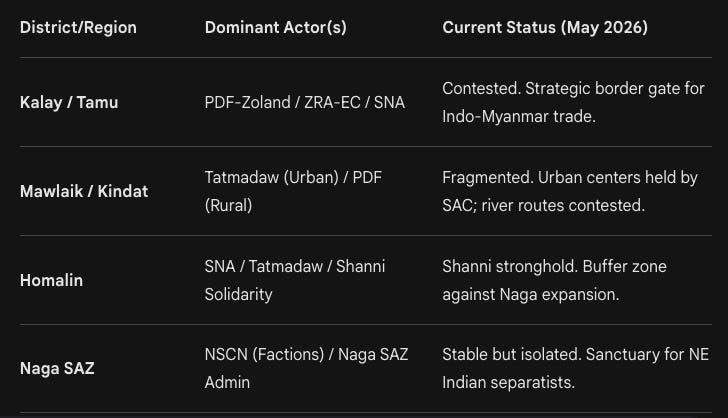
The River Artery: The Chindwin River remains the primary logistical highway. While the Tatmadaw maintains strongholds in administrative centers like Homalin and Mawlaik, the rural and riverine areas between them are largely uninhabited or under the control of local People’s Defense Forces (PDFs).
Colonial Infrastructure: The region is a time capsule; Mawlaik still features colonial-era bungalows and a golf course, and road connections remain underdeveloped, largely following the same tracks laid during the British era.
II. Ethnic Diversity and Emerging Polarities
The Upper Chindwin is a demographic mosaic where the future formation of a Federal Union will face a complex test. The region is home to Zo kindreds (Chin, Zomi, Kuki), Shan (specifically Shanni), Naga, and Bamar populations.
The Shanni-Naga Friction: In the north, tensions are high between the Shanni Nationalities Army (SNA) and Naga political groups. In early 2020, requests by Naga politicians to extend the Naga Self-Administered Zone (SAZ) into Homalin and Hkamti townships—historically Shanni-majority areas—sparked a rivalry that persists in the 2026 political landscape.
The Naga “Buffer” Zone: The Naga SAZ (Lahe, Leshi, Namyun) remains a unique administrative bubble. While the Union government continues to fund regional development (208 projects in the 2025-26 budget), the region serves as a sanctuary for several separatist groups from Northeast India, including ULFA, UNLF (Manipur), and factions of the NSCN.
III. Environmental Geopolitics: The Mining Surge
Under the cover of conflict and sparse oversight, the Upper Chindwin is experiencing an ecological crisis fueled by unregulated resource extraction.
Rare Earth and Gold Mining: Along the Uru River (a key Chindwin tributary) and the northern basin, satellite data from late 2025 reveals over 500 Chinese-led mining sites. These unregulated leaching ponds and toxic runoff now threaten to contaminate the entire Chindwin-Irrawaddy watershed.
The Conservation Gap: While environmental groups like the Myanmar Environment Institute (MEI) and the Darwin Initiative have attempted to establish “Community Action Plans” for wetland conservation in Hkamti, the 2021 coup and ongoing insecurity have halted most formal safeguards. The region’s biodiversity—home to the critically endangered Burmese Roofed Turtle—is currently at the mercy of illegal extraction.
IV. Conflict Situation: Transnational and Local Dynamics
V. Analyst’s Conclusion: The Path Forward
The Upper Chindwin is not merely a sub-district of Sagaing; its ethnic composition and geographic isolation make it a unique and separate strategic entity. The competition between Shanni, Chin, Zomi, Kuki, and Naga claims over territory—combined with the predatory nature of illegal mining—means that even a post-SAC Myanmar will face a significant challenge in bringing the “Kindat frontier” into a unified governance framework.
Strategic Warning: The unregulated mining boom along the Chindwin is not just an environmental issue; it is a cross-border security threat. Toxic runoff is beginning to affect livelihoods in the Dry Zone of Myanmar, potentially driving further displacement and conflict over dwindling clean water resources.
If you find this analysis valuable, consider supporting our work so we can keep these deep dives coming: https://buymeacoffee.com/zolandfrontier | Share on your social media.