
Date: June 30, 2026
Perspective: Regional Security Analysis
Status: Multi-Front Conflict / Elite Kinetic Deployments / Cartographic Subversion
I. The Collapse of the Post-President’s Rule Settlement
The lifting of President’s Rule in February 2026 and the subsequent formation of the state coalition government under Chief Minister Yumnam Khemchand Singh has completely failed to stabilize Manipur. Instead, the structural engineering of the conflict has transformed from localized ethnic clashes into an institutionalized, multi-front war of attrition.
The state remains strictly segregated into armed ethnic enclaves separated by artificial “Buffer Zones” monitored by central Indian forces—a policy that has de facto legitimized territorial partitioning. While a political configuration featuring a Meitei Chief Minister alongside representation from other highland communities was intended to restore administrative balance, security fractured irreparably following a high-intensity ambush on May 13, 2026, which killed three Thadou church leaders and disrupted fragile peace initiatives. The subsequent wave of retail violence has demonstrated that the buffer zones are highly porous and entirely unable to suppress sophisticated kinetic actions.
II. The New Front: The Naga-Kuki Confrontation
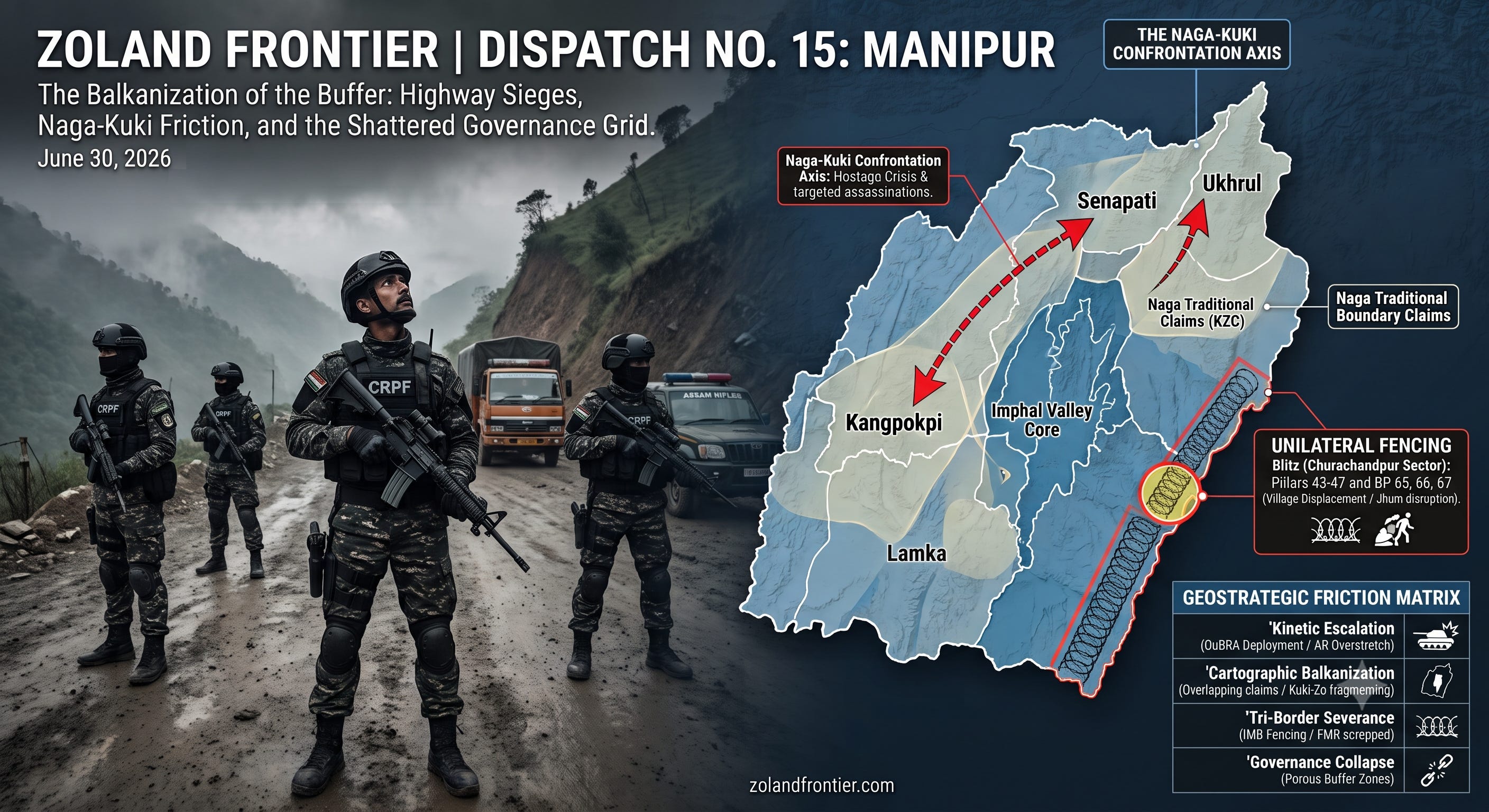
The most critical strategic shift in mid-2026 is the direct expansion of active hostilities beyond the initial Meitei vs. highland tribal binary into a dangerous, active Naga-Kuki conflict. This escalation stems from a volatile cycle of hostage-taking and targeted assassinations in the hill districts.
Chronology of the May–June 2026 Escalation
May 13, 2026: An ambush targets two vehicles, killing three Thadou church leaders who were working on dialogue initiatives in Nagaland. Hours later, a massive hostage crisis erupts, resulting in the abduction of dozens of civilians across Kangpokpi and Senapati districts.
June 9, 2026: Following structural intervention by the United Naga Council (UNC) and local church bodies, highland groups release the remaining 14 captives in a gesture aimed at de-escalating the crisis.
June 10–11, 2026: The security landscape darkens as the decomposed and dismembered bodies of six Liangmai Naga hostages—abducted on May 13 from the Leilon Vaiphei vicinity—are recovered by security forces.
June 25–26, 2026: The newly formed Kuki-Zo Council (KZC) chair, Henlianthang Thanglet, issues a public video statement expressing regret, calling the executions a “great mistake” committed during an outburst of emotion. Within 24 hours, the council issues a sharp clarification, retracting any implication of collective or institutional responsibility and asserting the apology was strictly on humanitarian and moral grounds.
Security Implications of the Naga Mobilization
The United Naga Council (UNC), alongside apex bodies like the Tangkhul Naga Long (TNL), has reacted with profound indignation, rejecting the KZC’s shifting statements and demanding immediate criminal prosecution. Naga apex bodies have escalated their demands directly to New Delhi, framing the actions as an intolerable provocation by groups operating under the 2008 Suspension of Operations (SoO) agreements. They argue these actions threaten to undermine decades of peace processes, expanding regional instability well beyond the Imphal Valley.
III. Cartographic Friction and Fragmented Sovereignty
The root of this multi-sided highland friction lies in overlapping territorial imaginations and the administrative mapping of the hills.
While the broader Zo people share fundamental cultural and ancestral ties across the tri-border frontier, political fragmentation has deepened within Manipur’s internal borders. A major point of domestic friction is the emergence of the Kuki-Zo Council, a terminology explicitly rejected by prominent regional student and youth organizations—such as the Zomi Students’ Federation—who champion distinct identities like Hmar and Zomi. These groups refuse to recognize the council’s claim to represent the collective umbrella, illustrating how localized political maneuvers can fracture broader transnational kinship alignments.
IV. The Militarization Turn: CoBRA Operations and Paramilitary Overstretch
The expanding threat landscape has driven New Delhi to shift its strategy toward direct kinetic militarization. Following the total exhaustion of local policing options, the Ministry of Home Affairs authorized the deployment of two elite battalions of the Central Reserve Police Force’s (CRPF) Commando Battalion for Resolute Action (CoBRA). Originally raised for specialized jungle warfare and counter-guerrilla operations in Left-Wing Extremism (LWE) theaters, these units represent a significant escalation in central counter-insurgency tactics within the state.
Central Strike Units vs. Local Realities
Kinetic Interventions: CoBRA commandos have targeted insurgent hideouts in highly sensitive highland sectors, such as Leilon Vaiphei, resulting in substantial seizures of military-grade hardware, including AK-47s, M4 carbines, and sniper rifles.
The Coordination Challenge: Unlike localized units, CoBRA operates via rapid, intelligence-led strike profiles. However, their insertion into complex local geographies has introduced friction with state actors and civil society organizations (CSOs), with groups like the TNL claiming operations are occasionally co-opted or lack deep local intelligence.
Assam Rifles and Overstretch: While CoBRA acts as a heavy kinetic strike component, the day-to-day burden of maintaining the fragile peace falls upon the Assam Rifles. Guarding the Indo-Myanmar Border (IMB) under their unique dual-control framework, they face severe operational overstretch. The force must simultaneously police internal ethnic buffer zones and secure a rugged frontier against the influx of weapons and non-state actors escaping the collapse of state authority across the border.
V. The Borderlands Imposition: Post-FMR Security Dilemma
The ongoing infrastructure push by the central government to complete physical border fencing along the 398-km Manipur sector of the Indo-Myanmar Border (IMB) has emerged as an explosive catalyst for frontier resistance. The state cabinet’s May 2026 decision to bypass prior stalemates and immediately commence a 27-km fortified fencing section in the Churachandpur sector—under package number 5 running between Border Pillars 43 and 47—signals New Delhi’s intent to enforce hard Westphalian boundaries over a fluid frontier zone.
VI. The Geography of Resistance: Realignment of Pillars 65-67
This militarized border management project has triggered severe friction with local traditional authorities, most notably manifested in the June 2026 declaration of total non-cooperation by village chiefs. In the Khengjoi sector, the chief associations formally petitioned the state government, flatly refusing land compensation and demanding an immediate halt to construction.
The primary geopolitical friction points center around the Ministry of External Affairs’ structural realignment of Boundary Pillars (BPs) 65, 66, and 67:
Village Displacement: The proposed alignment directly cuts through ancestral homesteads, leaving long-established frontier settlements like Molcham, Khengjang, Phaisenjang, and Khumkot physically divided or stranded beyond the fence line on the Myanmar side.
Disruption of the Jhum Economy: By slicing through customary jhum cultivation areas, wet-rice fields, and community burial grounds, the physical fence effectively severs the foundational socio-economic and survival mechanisms of these frontier populations.
The Fractured Consensus
The unilateral scrapping of the Free Movement Regime (FMR) and the subsequent construction blitz represent a central policy that views the borderlands strictly through a state-centric national security lens. However, this strategy has unified otherwise conflicting highland actors in their resentment of the project:
The Traditional Leadership: Village chiefs view the rushed implementation—devoid of ground verification or local consultation—as an institutional dispossession of their ancestral land rights.
The Naga Position: Even as the Naga-Kuki conflict intensifies internally over local jurisdiction, the United Naga Council (UNC) has historically rejected the current border demarcation, maintaining that their traditional boundaries extend to the Chindwin River in Myanmar and that the fence artificially severs vital cross-border kinship networks.
Concluding Analyst Note: New Delhi’s strategy of “peacebuilding”—relying on elite CoBRA operations to enforce domestic buffer zones while rapidly erecting a hard physical barrier across the IMB—fundamentally miscalculates the tri-border dynamic. Hardening an international border without settling the internal administrative architecture of the hills does not secure the frontier; it merely locks the state into a permanent cycle of fragmented sovereignty and multi-layered insurgency.
Geopolitics. Security. Transnational kinship. Zoland Frontier brings you essential perspectives from the frontlines of South and Southeast Asia. To sustain this independent, conflict-sensitive analysis, consider supporting our work.