
Date: June 21, 2026
Perspective: Senior Regional Analyst
Status: Littoral Warfare / Major Hydrocarbon Discovery / KNU Strategic Expansion
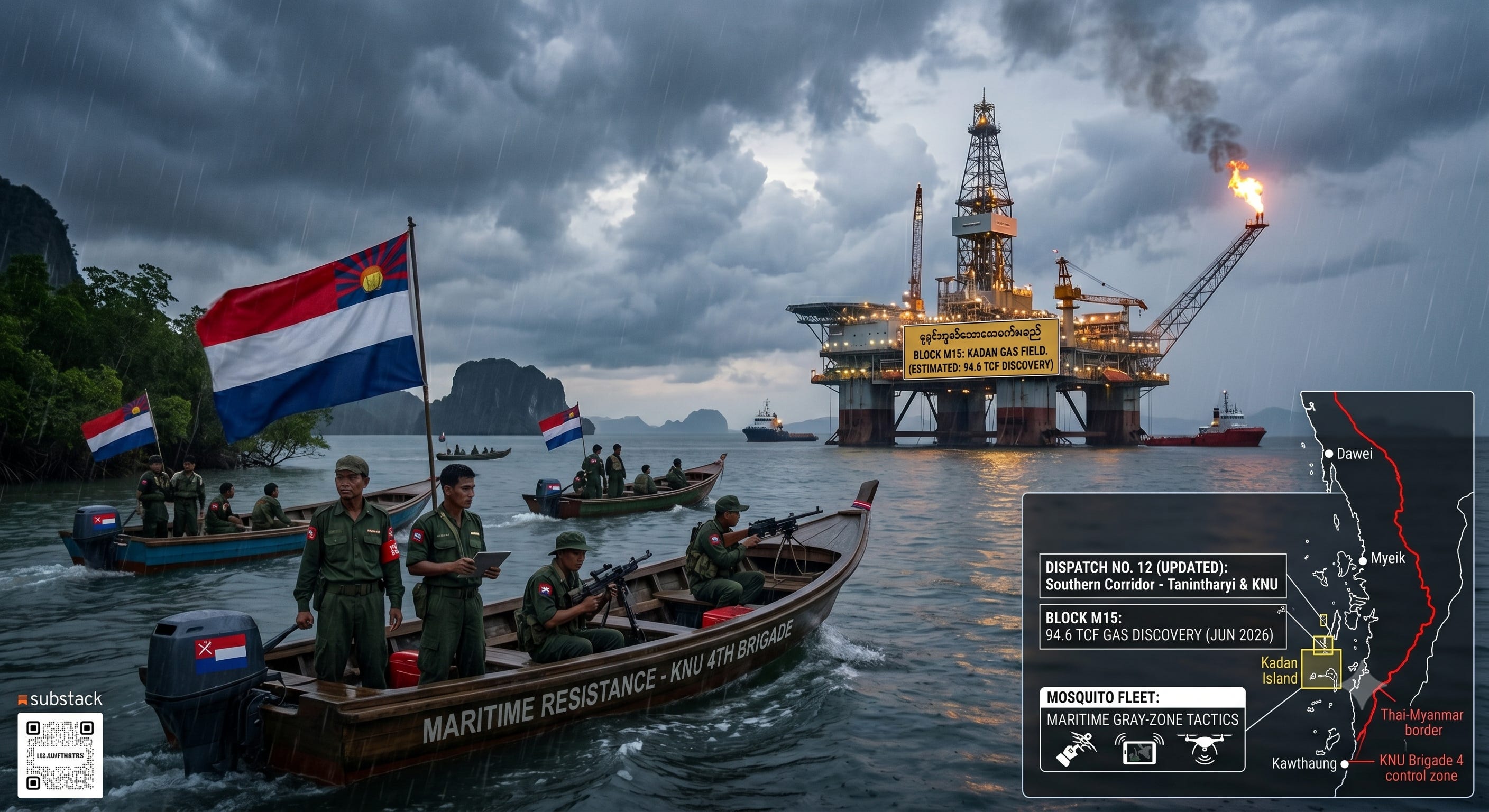
As the conflict in the Anyar heartland shifts toward a grinding war of attrition over public institutions, a completely different strategic paradigm is unfolding along Myanmar’s narrow southern tail. Tanintharyi Region, stretching along the Andaman Sea and bordering Thailand, represents the maritime frontline of the revolution.
Recent developments in June 2026—specifically a world-class offshore gas discovery—have instantly elevated the geopolitical stakes of this corridor. Here, the resistance is transitioning from traditional jungle warfare to a sophisticated coastal strategy, heavily anchored by the veteran leadership of the Karen National Union (KNU).
I. The KNU Backbone: Brigade 4 and the Overland Front
While local People’s Defense Forces (PDFs) are highly active in the southern corridor, the operational and political backbone of the Tanintharyi resistance is the KNU’s 4th Brigade (Mergui-Tavoy District).
The Patron of the South: Unlike the fragmented Pa-Ka-Pha units in Sagaing, the local PDFs in Tanintharyi operate under the strategic umbrella of the KNU. The Karen forces provide the necessary training, arms supply routes from the Thai border, and a unified command structure.
The Thai Border Choke Points: The KNU exerts significant pressure on the overland trade gateways, such as the Maw Daung pass. By regulating cross-border smuggling and taxing trade, the KNU funds the southern resistance while simultaneously forcing the Tatmadaw (Myanmar Armed Forces) to rely heavily on vulnerable coastal supply lines.
II. The M15 Megaproject: The Geopolitics of 94.6 TCF
In June 2026, the strategic calculus of Tanintharyi was upended. As reported by The Irrawaddy, the military junta announced one of the largest offshore natural gas discoveries in the world in Block M15, located in the Andaman Sea near Kadan Island.
The Hydrocarbon Lifeline: The massive deep-sea field is estimated to hold up to 94.6 trillion cubic feet (TCF) of natural gas. For a financially starved regime heavily sanctioned by the West, Block M15 represents a multi-billion-dollar lifeline.
Securing the Archipelago: This discovery explains the Tatmadaw’s ferocious defense of its coastal assets. The Myanmar Navy has intensified its patrols around the Myeik Archipelago, transforming the once-porous fishing waters into a heavily militarized exclusionary zone to protect the future extraction infrastructure.
III. The Maritime Resistance and Gray-Zone Tactics
Lacking a conventional navy to directly contest the Block M15 perimeter, the anti-junta forces (KNU and allied maritime PDFs) have adopted asymmetrical, gray-zone tactics to disrupt the Tatmadaw’s broader coastal logistics.
Non-Cooperative Maritime Monitoring: Utilizing open-source satellite remote sensing technologies—including Sentinel-1 Synthetic Aperture Radar (SAR) imagery and Automatic Identification System (AIS) data fusion—resistance intelligence is actively tracking Tatmadaw supply vessels, illegal transshipments, and governance gaps across the archipelago.
The Mosquito Fleet: Local resistance cells utilize modified, high-speed civilian vessels equipped with light weaponry and commercial drones to conduct hit-and-run raids on coastal outposts and naval logistics lines. This has forced the military to convoy its supply ships, slowing down its operational tempo.
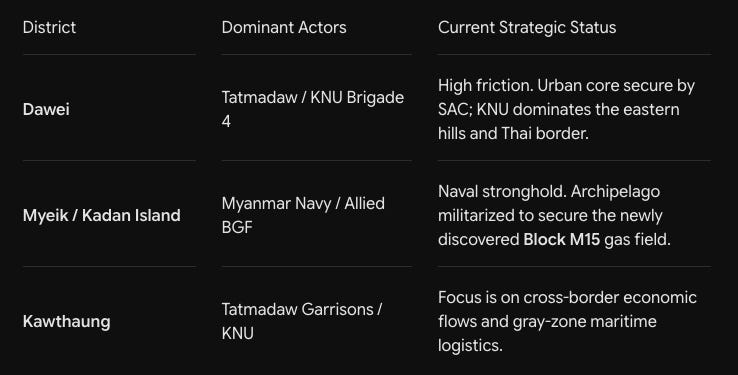
IV. Conflict Situation Matrix
V. Concluding Analyst Note: The Indo-Pacific Stake
The Southern Corridor is no longer a peripheral theater. The June 2026 announcement of the 94.6 TCF gas reserve in Block M15 transforms Tanintharyi into a primary geopolitical prize. Regional stakeholders—particularly Thailand (which relies heavily on Myanmar gas) and India—are watching closely.
A protracted naval insurgency along the Tanintharyi coast, combined with the KNU’s tightening grip on the eastern hills, threatens not just the junta’s newest financial lifeline, but the broader stability of international shipping lanes and regional blue economy frameworks in the Andaman Sea.
Next Deep Dive: Dispatch No. 13: The Western Seaboard – Arakan’s Naval Ambitions and the Bay of Bengal Frontier.
Geopolitics. Security. Transnational kinship. Zoland Frontier brings you essential perspectives from the frontlines of South and Southeast Asia. To sustain this independent, conflict-sensitive analysis, consider supporting our work.