
Date: June 11, 2026
Perspective: Senior Regional Analyst
Status: Hybrid Administration / Social Friction / Educational Coercion
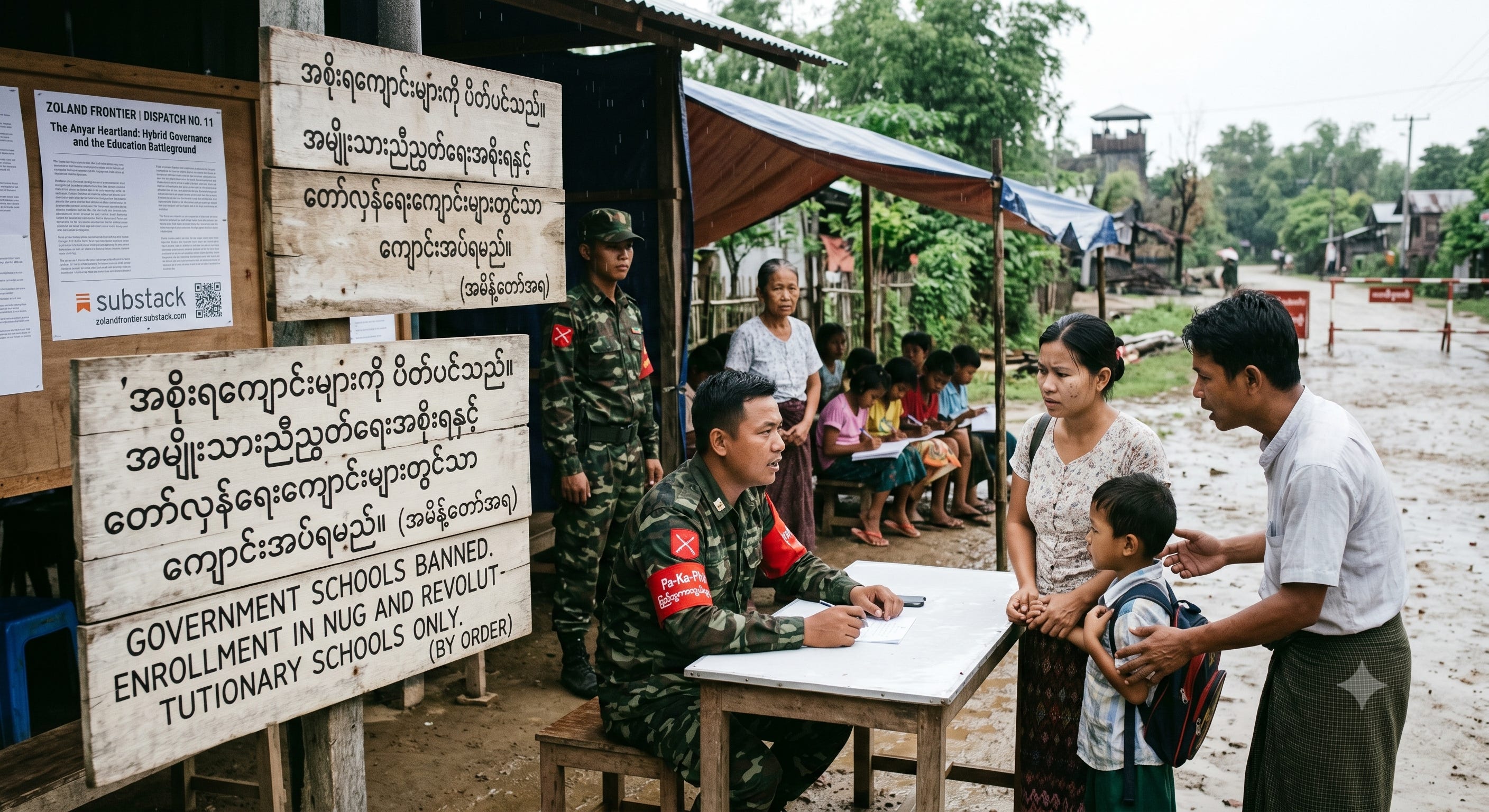
As we shift our focus from the established, resource-heavy proto-states of the northern borderlands to the Anyar Heartland (Sagaing, Magway, and Mandalay Regions), the nature of the Spring Revolution fundamentally changes. In the Bamar-majority center, the conflict is not defined by “Ethno-Sovereign” state-building under a single patron like the KIO or ULA. Instead, it is characterized by fragmented, hybrid governance where local defense forces are struggling to transition from guerrilla insurgents to legitimate civil administrators.
The latest developments in Sagaing highlight a dangerous inflection point: the battlefield has expanded from physical territory to the control of civilian life, specifically the education sector.
I. The Governance Vacuum and Pa-Ka-Pha Dominance
In vast stretches of rural Sagaing and Magway, the Tatmadaw (Myanmar Armed Forces) has been effectively pushed out, confining its administrative footprint to heavily fortified urban cores and major logistical arteries. Into this vacuum, a patchwork of local governance has emerged.
The PAB and Pa-Ka-Pha: Local administration is largely driven by People’s Administrative Board | ပြည်သူ့အုပ်ချုပ်ရေးအဖွဲ့ (PABs - ) and Pa-Ka-Pha | ပြည်သူ့ကာကွယ်ရေးအဖွဲ့ (People’s Defense Teams/Force). While the National Unity Government (NUG) attempts to coordinate these groups from afar, ground reality dictates that southern and central Sagaing operate highly independently, lacking the unified command structures seen in Kachin or Arakan states.
The Revenue/Service Pivot: These local bodies have developed their own taxation systems via road checkpoints to fund healthcare, defense, and education. However, the shift from raising funds to enforcing social compliance has triggered profound domestic friction.
II. The Education Sanctions: A Coercive Turn
The most critical flashpoint in the Anyar Heartland this month centers on a controversial series of directives issued by regional Pa-Ka-Pha units regarding civilian education.
The Boycott Mandate: Local Pa-Ka-Pha commanders have officially sanctioned and forbidden children from attending government schools operated by the Tatmadaw’s education ministry.
The “Revolutionary School” Directive: Parents are being coerced to enroll their children exclusively in NUG-accredited online programs or locally run “revolutionary schools.”
Enforcement: Reports indicate that Pa-Ka-Pha units are utilizing intimidation tactics—threatening to blacklist families or cut off community support for those who defy the boycott and send their children to Tatmadaw-run institutions.
III. Social Friction and the Public Backlash
This mandate has generated a deeply mixed and increasingly hostile response from the civilian population, threatening the very public mandate that the resistance relies upon.
The Civilian Dilemma: Parents feel trapped between two warring entities. While many harbor deep resentment toward the Tatmadaw, the revolutionary schools often lack physical infrastructure, accredited teachers, and security from aerial bombardment.
Accusations of Authoritarianism: The public and several prominent civil society groups are condemning the Pa-Ka-Pha for an overreach of power. The sentiment on the ground is that controlling where children go to school and dictating parental choices mimics the very authoritarianism the revolution is fighting to dismantle.
The Legitimacy Crisis: The NUG faces a severe credibility test. If it cannot rein in the coercive tactics of its local Pa-Ka-Pha units, it risks alienating the Bamar heartland—the demographic core of the resistance.
IV. Strategic Warning: The Geopolitics of Public Trust
The Anyar Heartland is currently experiencing the growing pains of decentralized revolution. Unlike the ethnic armed organizations (EAOs) on the borders, which have decades of experience in civil administration, the Pa-Ka-Pha are learning governance on the fly, often resorting to heavy-handed tactics when compliance wavers.
Furthermore, the international landscape is shifting. With the current 47th administration in Washington pivoting toward a highly transactional foreign policy, global attention and non-lethal aid for the Myanmar resistance are increasingly strained. The NUG and its local affiliates cannot rely on international rescue; their survival depends entirely on maintaining unbreakable domestic support.
Final Assessment: The revolution in the Anyar Heartland cannot be sustained through coercion. The education sanctions represent a strategic misstep that fractures community unity. To prevent the Tatmadaw from exploiting these internal divisions, the resistance must shift its focus from enforcing boycotts to providing viable, secure, and voluntary alternatives for public services.
Geopolitics. Security. Transnational kinship. Zoland Frontier brings you essential perspectives from the frontlines of South and Southeast Asia. To sustain this independent, conflict-sensitive analysis, consider supporting our work.