
Date: April 16, 2026
Location: Aizawl-Champhai Axis
Status: Strategic Buffer / Humanitarian Hub
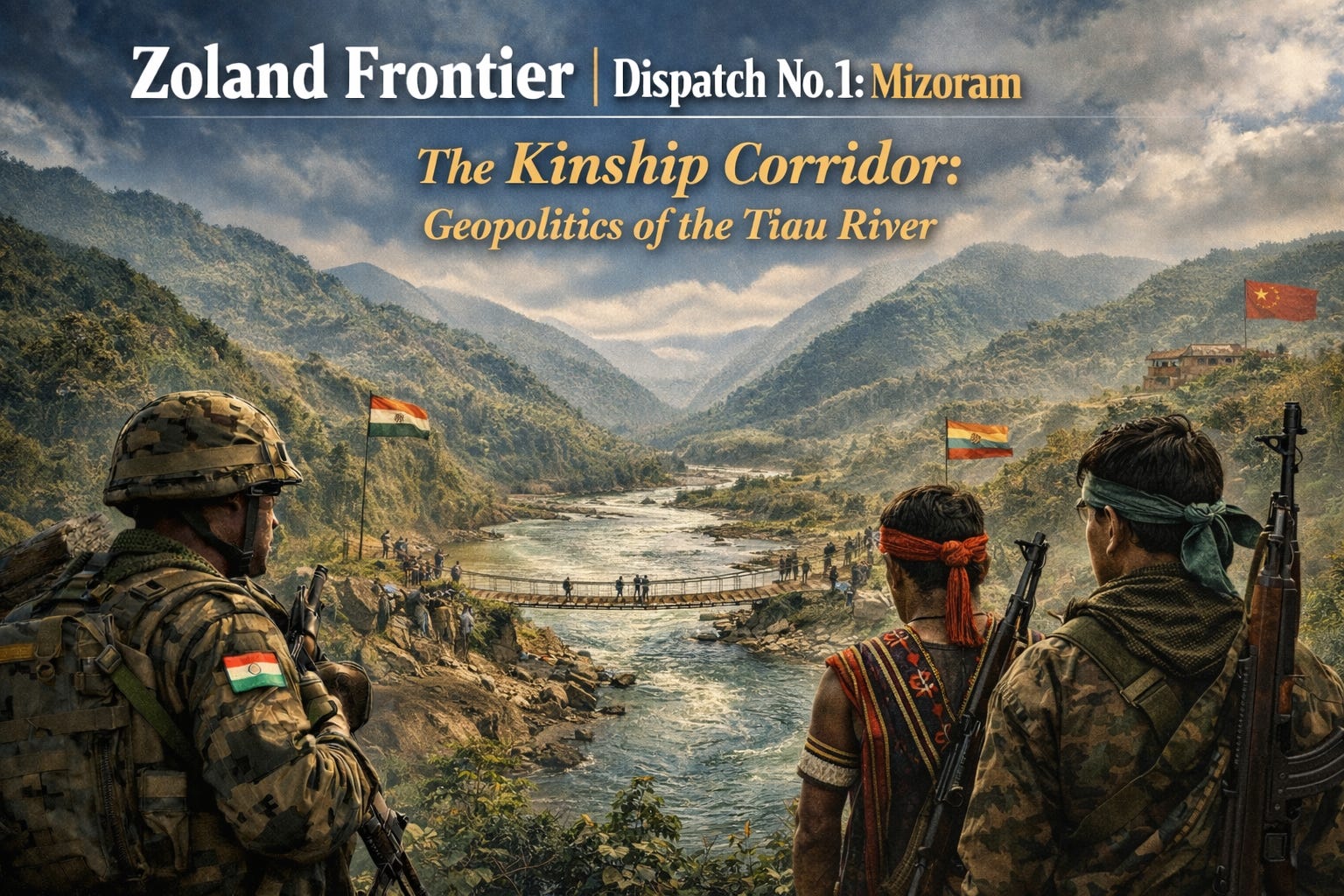
For decades, the 510-km border between Mizoram and Myanmar’s Chin State was a “forgotten” frontier. Today, it is the epicenter of a geopolitical shift where ethnic kinship has effectively overridden national cartography. As of early 2026, Mizoram has transitioned from a quiet highland state into a critical staging ground for the Myanmar resistance and a sanctuary for the “Zo” people—a trans-border ethnic umbrella encompassing the Mizo, Chin, Kuki, and Zomi.
I. The “Brother’s Keeper” Doctrine: Kinship Over Sovereignty
Since the 2021 coup in Myanmar, and exacerbated by the intensified clashes of 2024-2025, over 50,000 refugees (predominantly ethnic Chin) have sought refuge in Mizoram. Unlike other Indian border states, Mizoram’s response has been one of State-sponsored defiance.
Political Defiance: The Mizoram government (led by the ZPM) has consistently rejected federal directives from New Delhi to deport refugees. Chief Minister Lalduhoma has openly advocated for a “United Zo Nation,” a sentiment that resonates deeply across the Chin-Mizoram border.
The Humanitarian Infrastructure: Local NGOs like the Young Mizo Association (YMA) provide the primary social safety net. In border towns like Zokhawthar, the distinction between “refugee” and “citizen” is practically invisible, as families share homes across a river that is now more a bridge than a barrier.
II. Security & The Free Movement Regime (FMR) Crisis
A major point of friction in 2026 is New Delhi’s decision to scrap the Free Movement Regime (FMR) and fence the border.
The Federal Rationale: New Delhi views the open border as a conduit for insurgent movement, arms smuggling, and “illegal” migration that could alter the demographics of the Northeast.
The Local Backlash: To the Zo people, a fence is a “Berlin Wall” cutting through their ancestral living rooms. The Mizoram Assembly recently passed a resolution opposing the fence, arguing it validates “colonial-era borders” that the Mizo never accepted.
Insurgent Dynamics: While Mizoram is peaceful, its territory serves as a logistical rear-base for groups like the Chin National Army (CNA) and various PDFs (People’s Defence Forces). The Arakan Army (AA) now controls significant territory in Paletwa, just south of Mizoram, making the state the only reliable entry point for cross-border humanitarian aid.
III. The Economic Stagnation: The Kaladan Project
For conflict analysts, the Kaladan Multi-Modal Transit Transport Project—intended to connect Kolkata to Mizoram via Myanmar’s Sittwe port—is a bellwether for regional stability.
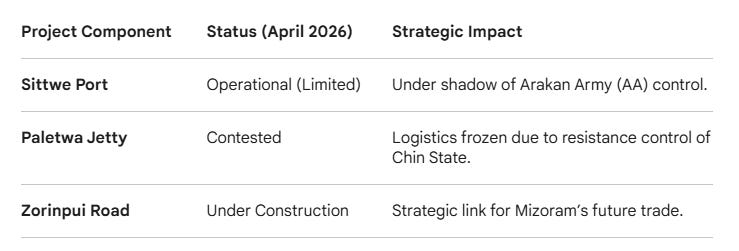
The “Chicken’s Neck” (Siliguri Corridor) remains India’s only physical link to Mizoram, as the Kaladan project remains a “hostage to history” until the Myanmar civil war finds a political resolution.
IV. Strategic Outlook for 2026
For international observers and diplomats, Mizoram represents a “Managed Chaos.” It is the only place in the region where an Indian state government, civil society, and a foreign resistance movement are in a de facto alliance against a neighboring military junta.
Key Risks to Watch:
Resource Exhaustion: After five years of hosting refugees, Mizoram’s local economy is fraying. International humanitarian professionals must note the shift from “welcome” to “resource competition.”
Drug Trafficking: The “Golden Triangle” is moving closer. High-grade methamphetamines are increasingly entering Mizoram from Myanmar, threatening to destabilize the social fabric.
New Delhi’s “Hard Border” Policy: If the central government forces the fencing project, expect a spike in civil disobedience and a potential strain on the 1986 Mizo Peace Accord.
Investigative Note: Watch the Tiau River crossings. As the junta loses more outposts in Chin State, these crossings are evolving into the primary trade veins for the “New Myanmar” emerging under resistance control.
Zoland Frontier | Investigative Note: Mizoram
The “State-Sourced” Sanctuary
While Mizoram appears to be a success story of humanitarian kinship, the investigation lies in the legal and economic friction between the state and the federal center.
The “Shadow” ID System: While New Delhi has refused to grant formal refugee status to those fleeing Myanmar, the Mizoram government has issued its own “Identity Certificates” to over 30,000 displaced persons.
The Lead: These certificates are not recognized by the Indian Home Ministry, yet they allow refugees to access local schools and healthcare. Investigation into the funding of these services reveals a significant “off-budget” reliance on Mizo diaspora contributions from the US and UK, bypassing official FCRA (Foreign Contribution Regulation Act) channels.
The Zokhawthar Logistics Loop: The border town of Zokhawthar has become a “Dry Port” for the Myanmar resistance.
The Findings: Beyond food and medicine, there is a steady flow of “dual-use” technology—high-capacity power banks, satellite phones, and heavy-duty rain gear—moving across the Tiau River. Our field notes suggest local traders have established a “Resistance Tax,” where a percentage of trade profits is diverted to support Chin defense volunteers.
The “United Zo” Political Undercurrent: Chief Minister Lalduhoma’s rhetoric regarding “Zo Reunification” is often dismissed as populist posturing.
Evidence suggests a growing coordination between the Mizo Zirlai Pawl (Student Union) and Chin student bodies to standardize the Zo language and curriculum across the border. This is a “soft” annexation of identity that is deeply alarming to New Delhi’s intelligence agencies.
If you find this analysis valuable, consider supporting my work so I can keep these deep dives coming: https://buymeacoffee.com/zolandfrontier